


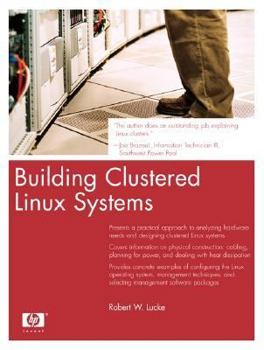
Building Clustered Linux Systems

Praise for Building Clustered Linux Systems "The author does an outstanding job of presenting a very complicated subject. I very much commend this work. The author sets the pace and provides vital... This description may be from another edition of this product.
Format:Paperback
Language:English
ISBN:0131448536
ISBN13:9780131448537
Release Date:September 2004
Publisher:Prentice Hall
Length:606 Pages
Weight:2.00 lbs.
Dimensions:1.3" x 7.0" x 9.2"
Customer Reviews
5 ratings
Outstanding value
Published by Thriftbooks.com User , 19 years ago
This book is a very straightforward, clearly written and valuable introduction to Linux clustering. Geared toward system folks, it also provides numerous `on-ramps' into the basics of clustering to accommodate quick, relevant review of supporting technology for the reader. It is essentially a map for getting from start to finish in any Linux cluster project. Specific situations, conditions, and expectations differ across projects, of course, and such points are identified well in the text with pointers to additional information provided. Scientific computing (HPC) is addressed well, and is more of the topic than any other cluster flavor, though the others are discussed as well (after all, who wouldn't want a side order of high availability with their HPC?). My cluster background personally was mostly high availability (Microsoft Wolfpack), so I appreciated the HPC overview, especially since I was already building a Linux cluster for my bio-algorithms that depended on HPC. This book helped me get every gflop out of my admittedly 2ndhand student hardware. If you are getting involved with a cluster project or have one potentially on the horizon, and need a clear overview of what may lay ahead, pick up this book. For its measly sticker price, you get two solid discussion weeks with an expert. Go calculate that one:) 5 stars
Hard to beat. Full Marks !!
Published by Thriftbooks.com User , 19 years ago
The book describes in simple reproducable steps how to build a medium to medium big sized cluster. It also devides the clusters into the three main types, HPC *High performance computing, High Throughput and High Availability cluster and describes their usages. The book is describing cluster projects more from a bird view and gives a whole sight overview including budget calculations, comparing several architectures also by their technology and environmental conditions (Power usage, Cooling requirements etc.). The book is not only hard to beat but also the perfect companion to the Linux Enterprise Cluster from Karl Kopper. While Karls book is a bit more practical it concentrates only on the technical configuration of "small" clusters. Here is where Lubke comes in and extends that knowledge by the many environmental factors *Budget, technical considerations, Calculations, Estimates, Planning what to expect from your hardware *Performance, Weight, Heat, Flooring considerations etc. After you read the book, you will have learned all necessary steps to build your own clusters. The "only" thing left to you is to put the ship to water ;-) An incredible book and a real eye opener !!
Exquisitely detailed, eminently practical, quite readable
Published by Thriftbooks.com User , 21 years ago
I'm a sr software engineer who deployed to server farms and occasionally writes parallelized software for deployment to our linux cluster. While reaching depths of detail even beyond my interest or understanding, Lucke explains very clearly how clusters work, how they should be designed and tuned, and why this is a compelling architecture for a wide variety of computing problems. The book covers hardware, software, networking, NFS issues, data and system security and management - even the business/economic implications and the physical heat limits of various installations. The most comprehensive, accurate and accessible book on linux clusters.
Extremely thorough
Published by Thriftbooks.com User , 21 years ago
This book addresses Linux clusters in an extremely thorough fashion. There is an excellent history and description of the problem to arrive at the definition of a "Linux cluster". The different types of clusters (high performance, throughput, availability) are well described so you know what the goal is of the cluster you will be working on. There are well-defined objectives at the start of each chapter. I also found the transition from theoretical to practical to be very good. I am impressed with this book.
This is the place to start.
Published by Thriftbooks.com User , 21 years ago
Cluster supercomputers became originated when NASA had a need for another supercomputer but no budge to buy one. The particular tasks that they needed to perform tended to have a lot of parallelism. That is, they could benefit by having a bunch of systems work on small tasks and then bring the results together. An example of an ideal parallel application is provessing seismic data. Basically you have the signals to process from a bunch of sensors and each data stream is independent of the other until the end of the process. An example of a non-parallel system is inventory. When you are increasing or decreasing inventory, you only have one bin of this part, and two CPU's better not sell the same part twice. Anyway Don Becker and some others proposed using a cluster of PC's to handle the tasks. They wrote a software package called Beowulf to run under Linux. Linus had two real advantages: stability and cost. It's much more stable than Microsoft systems and it's free. This, as is often the case in the computer biz, started a landslide. This book is the most complete I've read on how to build a cluster. It goes extensively into every aspect. It talks about the architecture of the various CPU's in use (Itanium, Xeron, Opteron), high speed interconnection systems (Myricom, Infiniband, Dolphin, Quadrics), available software (Suse, Red Hat, management systems) -- in short everything you need to get the system up and running. If you're new to clustering, here is an integrated, step by step approach to getting the system up. Of course you'll need more books later (FORTRAN, Message Passing Interface, etc.) but this is the place to start.
Copyright © 2025 Thriftbooks.com
Terms of Use | Privacy Policy | Do Not Sell/Share My Personal Information | Cookie Policy | Cookie Preferences | Accessibility Statement
ThriftBooks ® and the ThriftBooks ® logo are registered trademarks of Thrift Books Global, LLC
ThriftBooks ® and the ThriftBooks ® logo are registered trademarks of Thrift Books Global, LLC
