


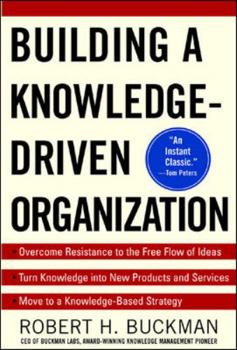
Building a Knowledge-Driven Organization


Select Format
Select Condition 
Book Overview
This is the first book to focus on the people side of knowledge management--what it takes to get employees to contribute to a knowledge system. Robert Buckman explains how to orchestrate this culture change, drawing from the lessons learned by Buckman Laboratories--the leader and pioneer in knowledge management--in implementing award-winning knowledge systems. His book is a practical primer on how organizations can move from "hoarding" knowledge to "sharing" it, building a global strategy that allows them to respond faster than the competition to any customer's need on a global basis. Buckman reveals how to:
Combat the biggest problem with implementing knowledge management--creating the culture that supports it Increase the speed of innovation globally across an organization Resolve technical problems quickly Make immediate, informed decisions to help solve customer issues Create new products based on customer input and demandFormat:Hardcover
Language:English
ISBN:0071384715
ISBN13:9780071384711
Release Date:March 2004
Publisher:McGraw-Hill Companies
Length:300 Pages
Weight:1.30 lbs.
Dimensions:1.0" x 6.2" x 9.3"
Customer Reviews
2 ratings
You won't regret picking up Robert Buckman's Building a Knowledge-Driven Organization!
Published by Thriftbooks.com User , 17 years ago
Elevator pitch Robert Buckman is the CEO emeritus of Memphis, TN chemical vendor Buckman Laboratories. I discovered his 2004 book Building a Knowledge-Driven Organization during a hopeful search on "knowledge management" at a Memphis Library kiosk. This was my first real offline research in the collaboration field and I was pleased to find such a good-looking book with multiple copies on the shelf. The jacket copy bills Buckman Labs as a bleeding-edge leader in the knowledge management space, winning awards by setting high knowledge management standards for more hidebound companies to chase. The book gets interesting in a hurry when Buckman starts tossing out traditional knowledge management ideals and downplays the extensive use of technology in his successful knowledge initiatives. Overcome outdated priorities through culture change This book's fundamental principle is that knowledge is the most valuable asset a globally competing company can have. Workers create and store knowledge in the course of their jobs. Customers hold vital knowledge that can reshape the goals and processes of your company. Employees change jobs and companies and the knowledge they have accumulated in their former positions needs to be tapped. Buckman argues that by putting in place a culture of knowledge sharing and openness a company positions itself to excel. This culture is to be created by setting company-wide values of knowledge sharing and spending heavily on facilitating technology. Buckman is the sort of boss whose employees always have the best computers money can buy - he doesn't want to worry about a high-priced employee losing valuable work time to inferior tools. Change from the top Buckman is insistent that a new culture of knowledge sharing will not be successful unless it comes with the visible support and participation of the top official. The book includes several excerpts from Buckman Labs' internal forums highlighting CEO participation in high-profile issues. My favorite was a thread on sales awards - the company's salespeople felt that their reward program was insufficient. Public debate (on the web forum) involving salespeople, Buckman, and managers led to a new system: Rather than giving a big check to the top 1 or 2 salespeople in a period, many smaller bonuses were awarded to people improving sales above a certain percentage. This newer and more attainable goal provided a better incentive to the vast majority of salespeople who simply weren't in the right position to be #1 or #2 each year. This anecdote was a great example of Buckman's presence and obvious concern for his employees driving adoption of a collaborative system. This type of dialogue can be imagined all across the enterprise from new product design to inter-departmental collaboration to emergency problem solving. Every employee needs to participate The entire book tears down traditional "command and control" style management in favor of a philosophy of facilitation. Much like
Superb book, my choice for gift to colleagues
Published by Thriftbooks.com User , 21 years ago
Every once in a while airport bookstores carry something truly extraordinary. This is such a book. It is so utterly perfect, sensible, readable, and on target that Monday I am buying copies to give to colleagues I know are interested in making more of our global information accessible and actionable. I am sure this book will alter the perceptions of any management team in any domain. At a larger level of international information sharing, what the Swedes are calling M4 IS (multi-national, multi-agency, multi-disciplinary, multi-dimensional (or multi-domain) information sharing), this book is the single best and most practical book for turning Industrial era organizations into Information era organizations. There have been other great books that captured some of these ideas early on, from the popular (Alvin and Heidi Toffler's POWERSHIFT, Paul Strassmann's Information PayOff) to the inspired (Thomas Stewart's Wealth of Knowledge, Barry Carter's Infinite Wealth : A New World of Collaboration and Abundance in the Knowledge Era), but this is the one that I think absolutely must be read by every flag officer and every colonel aspiring to be a flag officer, and their counterparts across all industries. Heavily marked up, this book is already a classic. The author is brilliant in an elegant understandable manner in making several key points in an action-oriented implementation-facilitating fashion: 1) Technology is the easy part--changing the culture is the hard part (from information hoarding to information sharing) 2) Command and control stovepipes are a big part of the problem--we have to nurture trust and responsibility in all levels by giving all levels access to all information (within reason). 3) Communications, computers, and library services as well as external business intelligence services all have to be rolled together under one executive that has "direct report" relationship with the CEO--it is the networking of humans and their knowledge that has value, not the hardware and software and hard-wired comms lines 4) If you are not rolling over half your software and hardware each year, with nothing in your C4I system more than two years old at any one time, then you are losing capacity, productivity, and profit 5) 85% of what you know cannot be captured in structured knowledge archives--only a living network can allow employees to provide just enough, just in time articulation of answers that can be created in real time--this allows a *dramatic* shortening of the business information answer cycle, from months to hours. 6) If the CEO does not get it, live it, and enforce it, it will not happen. The author shares with us practical real-world experience that makes this book a real-world manifestor rather than just a visionary proposal. His practical suggestions lead directly to the possibilities of global issue networks such as J.F. Rischard recommends in his HIGH NOON: Twenty Global Problems, Twenty Years to Solve Them, but
Copyright © 2026 Thriftbooks.com Terms of Use
| Privacy Policy | Do Not
Sell/Share My Personal Information | Cookie Policy | Cookie Preferences | Accessibility Statement
ThriftBooks® and the ThriftBooks® logo are registered trademarks of Thrift Books Global, LLC
ThriftBooks® and the ThriftBooks® logo are registered trademarks of Thrift Books Global, LLC
