


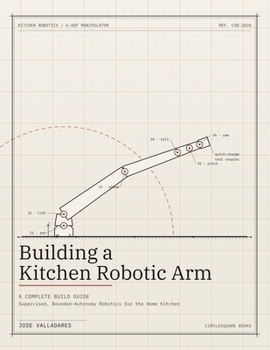
Building a Kitchen Robotic Arm: A Complete Build Guide: Supervised, Bounded-Autonomy Robotics for the Home Kitchen

Most kitchen-robot projects look impressive in a video and fail the moment the camera moves. Building a Kitchen Robotic Arm takes the opposite approach: it teaches you to build one modest, well-characterized 6-DOF arm that does a small set of real tasks reliably, under human supervision, in a workspace you control.
This is a complete build guide, from first principles to a working machine. You will design the mechanics, choose and size the actuators, wire the electronics and a fail-safe emergency-stop chain, write the kinematics and control code, calibrate the arm, add computer vision, and compose the whole thing into supervised tasks.
What you will buildA 6-DOF arm with stepper-driven proximal joints and smart-servo wrist axesA quick-change tool coupler with five starter tools: parallel gripper, dish hook, silicone stirrer, sponge holder, and spray-bottle adapterA Raspberry Pi + Arduino control stack with a 1 kHz joint loop, heartbeat watchdog, and current-based collision detectionA computer-vision pipeline using a depth camera for object detection and grasp planning What it actually doesSupervised warm-liquid stirring. Bounded pick-and-place of rigid ingredients. Countertop wiping and spraying. Moving clean, dry plates and handled mugs. And a supervised end-to-end "morning coffee" demo that ties it together.
It is equally honest about what it will not do - no knives, no frying, no dirty sink dishes, no unsupervised operation. Every task has a defined envelope, and nothing runs outside it. That discipline is the point.
Inside the bookFull mechanical design: reach, payload, stability, and tolerancesActuation sizing with real torque-margin and thermal mathA complete, costed bill of materials with suppliers and alternatesForward and inverse kinematics, PID control, and motion planning - with working codeA four-layer software safety stack on top of the hardware e-stopA companion code repository, a 3D-printable parts index, troubleshooting guides, and a food-safety appendixWritten for makers, students, and engineers comfortable with basic Python and a 3D printer. If you want a grounded, buildable robotics project instead of a demo that doesn't survive contact with a real kitchen, this is your blueprint.
Customer Reviews
ThriftBooks ® and the ThriftBooks ® logo are registered trademarks of Thrift Books Global, LLC
