


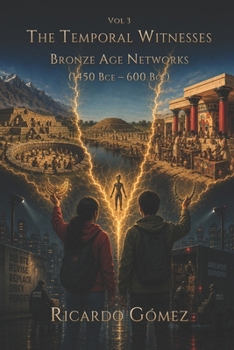
Builders of Monuments: The Temporal Witnesses, Volume 2
No Customer Reviews

The Temporal Witnesses Volume 2: Builders of Monuments Three places, three eras, and forty-eight hours that have to cover all of them. Cuchu Ramirez has just watched a man with federal funding behind him tell a hotel conference room that her ancestors were too primitive to build anything worth remembering. That evening Dr. Sarah Crow Feather opens three wooden boxes in a university basement: a carved stone head, a copper plate polished to mirror brightness, a chunk of rough stone with faint marks on it. Touch them, she says. Forty-eight hours in the past is forty-eight minutes here. Come home from the ground you arrived on. She does not mention that the forty-eight hours are for all three places together. Three Continents. Three Eras. One Clock. SAN AGUST N, COLOMBIA, 300 CE: A valley of workshops in the upper Magdalena, statues standing waist deep in the earth with their faces half out of the block. A carver named Suaya puts a hammer stone in Cuchu's hand and shows her where the grain runs. On the ninth blow Cuchu takes a piece off a face that one family has been working on for four generations. Nobody shouts at her. By the end of the afternoon she understands why that is worse. SPIRO MOUNDS, OKLAHOMA, 1200 CE: A gateway on the Arkansas river, where copper comes down from the Great Lakes and marine shell up from the Gulf. A route floods and three seasons of copper are stranded in the river. Matias watches a valley answer by telling more people rather than fewer, and then watches the evening meeting take as long as it takes and go against a man called Kolan, who says his part and will still be there next year. STONEHENGE, ENGLAND, 2500 BCE: Two uprights lying on timber beds with the sockets already cut, fires burning along a bank that is five hundred years old, and four hours until the sun comes up beside the heel stone. Cuchu can see through her own hands. The one useful thing she brought with her is the mistake she made in Colombia. They cannot change any of it. That is the rule of this series and the book does not bend it. What they can do is stand in it, pull on a rope, and come home able to say what they saw, to a country in which saying it is becoming expensive. The book ends with two documents. Cuchu's field journal, in her own hand, false starts and crossings-out left in, with one line she can no longer read. And a Historical Note in the author's voice that walks back through her three places and says which people in them were invented, what the archaeologists actually argue, and where this book disagrees with them on purpose. Perfect for fans of: Ursula K. Le Guin's ethical complexity, the argument Charles Mann started in 1491, and anyone who would rather know what six hundred hand-carved statues and one unfinished stone circle actually took.
Format:Paperback
Language:English
ISBN:B0FQV7MTG4
ISBN13:9798264944895
Release Date:September 2025
Publisher:Independently Published
Length:62 Pages
Weight:0.19 lbs.
Dimensions:0.2" x 6.0" x 9.0"
Customer Reviews
0 rating
Copyright © 2026 Thriftbooks.com
Terms of Use | Privacy Policy | Do Not Sell/Share My Personal Information | Cookie Notice | Cookie Preferences | Accessibility Statement
ThriftBooks ® and the ThriftBooks ® logo are registered trademarks of Thrift Books Global, LLC
ThriftBooks ® and the ThriftBooks ® logo are registered trademarks of Thrift Books Global, LLC
