


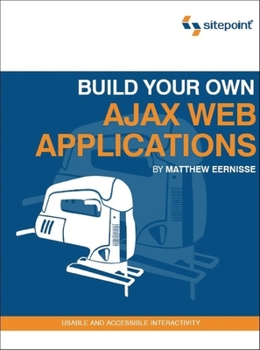
Build Your Own Ajax Web Applications: Usable and Accessible Interactivity

AJAX (Asynchronous JavaScript and XML) is a new approach for developing web applications. It essentially permits users to interact with a Webpage without forcing a slow & tedious reload of the entire page after every action. This means web applications become more responsive, easier to use, and more intuitive.Build Your Own Ajax Web Applications uses a step-by-step tutorial format that's so easy to follow, you'll be able to build sophisticated and intuitive Ajax web interfaces in no time!
Read this book, and you'll:
Throughout the text, the author stresses usability, accessibility, and graceful degradation for older, less-capable web browsers.
Format:Paperback
Language:English
ISBN:0975841947
ISBN13:9780975841945
Release Date:June 2006
Publisher:Sitepoint
Length:352 Pages
Weight:1.20 lbs.
Dimensions:0.6" x 7.0" x 9.0"
Customer Reviews
5 ratings
Learn how to use REST, SOAP and others in the process
Published by Thriftbooks.com User , 19 years ago
Ajax can create high-powered, responsive websites and Matthew Eernise's Build Your Own Ajax Web Applications offers the key to unlocking this power, showing how to build interactivity to web site using JavScript and AJAX applications. Developers - especially those new to AJAX's potentials - will find plenty of tips on using its features, including those to minimize common problems and maximize gains. Learn how to use REST, SOAP and others in the process, and build arrays using the code and steps supplied here. Diane C. Donovan California Bookwatch
Great book for both beginners and experts
Published by Thriftbooks.com User , 19 years ago
If you're looking into expanding your web development knowledge and want to learn how to build more responsive desktop-like web pages and applications, this book is for you. The book starts with the basics, but even if you already know what XMLHttpRequest is, there's a lot to discover in the book - things like dealing with loss-of-scope in JavaScript, avoiding Internet Explorer's memory leaks, do-it-yourself progress animations, transitions and drag-and-drop, among others. In the book you'll find practical examples of consuming web services and working with all kinds of data transfer formats and protocols - XML, JSON, YAML, SOAP, REST, RPC. The book has a list of available JavaScript libraries (such as Prototype and Yahoo UI), but will not teach you how to use them. Instead you'll learn how to do the JavaScript yourself; this will definitely help if at some point you decide to start using any of the available libraries and toolkits. PHP is used as a server-side language, but this part is pretty simple and can always be replaced with your favorite back-end language. From this book you'll learn how to do the AJAX things that make you "wow" on today's next generation of web applications, but it doesn't stop there. It also talks about accessibility and teaching you how to make your applications usable in screen readers, building upon the idea of the so-called "progressive enhancement", which basically means you should make your page content available for even the most incapable browsers and devices (think plain HTML), and then provide more (like more interactivity) for the more sophisticated browsers. The book follows all the best practices and standards I could think of, plus a few I wasn't even aware existed. Highly recommended.
Thank you
Published by Thriftbooks.com User , 19 years ago
The book is new and came before the specified time. Thank you.
Nice walkthrough, but a little too shallow
Published by Thriftbooks.com User , 19 years ago
I like the writing in this book. The author definitely knows his stuff. The design of the book is a set of case studies that show how AJAX is used in various applications. And through those examples you learn not just AJAX but also the DOM and CSS. My only gripe with the book is that it didn't go far enough. It's deep enough to get your toe wet. But when you want to get deeper you will need to get other books like the excellent "Dynamic HTML" book from O'Reilly.
Great Ajax book
Published by Thriftbooks.com User , 19 years ago
The craze of Ajax has publishers rushing their own Ajax books to market to get a piece of the Ajax pie so to speak. This book sets itself apart from the other Ajax books for one reason...Clear, concise explanations with no confusing terminology! The author uses code snippets, browser results snapshots, and nice white space to allow the reader to digest what the author is talking about without getting overloading with techno-babble. In my opinion, the most important part in learning Ajax is not the fancy DOM effects or the server-side coding to pull the data; it is understanding how you need to use the XMLHttpRequest object in sending and receiving requests from the server. The way we program our web applications to send and receive data from the server has changed with Ajax and this book shows the reader in gradual steps how to utilize the Ajax pieces in creating some useful editions to your website. This book assumes you have knowledge of CSS and JavaScript, but that's it. You don't have to be a guru in either, just have a good basic understanding of each. The rest will be supplied by the author's code examples. Actually reading this book and learning Ajax will help you create better accessible website (even if you don't use Ajax), because it focuses on using technologies where they can degrade nicely if the user of the site does not have the most up-to-date browser or is using a screen reader which would definitely hinder on the web experience. The most important chapter(s) in my opinion are Chapters 2, 3 and 4 where the author explains in great detail the XMLHttpRequest object and how is it is used to send a request asynchronously in getting requests from the server. I really like (as mentioned before) how the author stresses graceful degradation in case the object is not supported in the user's browser. Most of the other books that I have read through on Ajax do not even mention this and is a vital part in creating accessible web sites. Chapter 3 continues the theme on understanding the basics of asynchronous server requests with some useful examples that can be used right away in most websites. IE issues on memory leaks (hopefully eliminated with IE7), CSS and JavaScript differences are also discussed. Of course most other books slip other these simple things that can cause you hours of debugging and research on your part. Chapter 4 is the meat and potatoes of using GET and POST and how different salutations would lead you to using either one. Some nice useful, "real-world" examples are show and I have already incorporated one of these already. The author shows you how to incorporate Ajax in a simple login page to make it look more professional. Another topic in this chapter that I have never seen in another Ajax book is how Ajax is can be used with screen readers and has information on how to test it for (JAWS, IBM Home Page, Windows-Eyes, and Hal). That is another great addition that should be in every Ajax book (and actually most
Copyright © 2026 Thriftbooks.com Terms of Use
| Privacy Policy | Do Not
Sell/Share My Personal Information | Cookie Policy | Cookie Preferences | Accessibility Statement
ThriftBooks® and the ThriftBooks® logo are registered trademarks of Thrift Books Global, LLC
ThriftBooks® and the ThriftBooks® logo are registered trademarks of Thrift Books Global, LLC
