


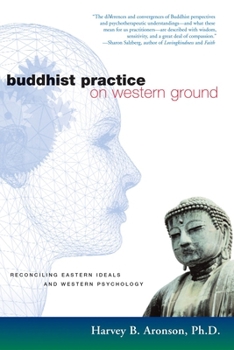
Buddhist Practice on Western Ground: Reconciling Eastern Ideals and Western Psychology

Select Format
Select Condition 
Book Overview
This is the first book to offer Buddhist meditators a comprehensive and sympathetic examination of the differences between Asian and Western cultural and spiritual values. Harvey B. Aronson presents a constructive and practical assessment of common conflicts experienced by Westerners who look to Eastern spiritual traditions for guidance and support--and find themselves confused or disappointed. Issues addressed include: - Our cultural belief that anger should not be suppressed versus the Buddhist teaching to counter anger and hatred - Our psychotherapists' advice that attachment is the basis for healthy personal development and supportive relationships versus the Buddhist condemnation of attachments as the source of suffering - Our culture's emphasis on individuality versus the Asian emphasis on interdependence and fulfillment of duties, and the Buddhist teachings on no-self, or egolessness
Format:Paperback
Language:English
ISBN:1590300939
ISBN13:9781590300930
Release Date:August 2004
Publisher:Shambhala
Length:272 Pages
Weight:0.88 lbs.
Dimensions:0.7" x 6.0" x 9.0"
Customer Reviews
5 ratings
Eastern Philosophy and Western Psychology: Where the Twain Shall Meet
Published by Thriftbooks.com User , 19 years ago
For more than half a century scholars and psychologists have been trying to see whether the practices and philosophy of Eastern religions and philosophical systems can be engaged with Western psychology. Some of the finest attempts at doing this have come from Ken Wilber, Roger Walsh and Frances Vaughan. To their number we should now add the name Harvey Aronson. I do not know him, but I read that he is a psychotherapist and Buddhist lecturer and this is one of the most comprehensive attempts to examine the basic differences and convergences between Asian and Western cultural and spiritual values. This is far from being an arcane topic. Virtually every meditation teacher has been struck by the amount of psychological work that we need to do. Not just at the outset, but, as practice continues, many psychological issues tend to come up. Often people find themselves struggling with the apparent contradictions of being a Christian and needing therapy. Or alternatively of being a Western practitioner of Buddhism who enters therapy and then has to try and reconcile the apparent contradictions between a meditation practice that stresses the gradual dissolution of the ego and social inter-dependence, with therapeutic models that tend to emphasize ego-strengthening, autonomy and individuality. The influential Chögyam Trungpa, founder of Naropa University in Boulder, talked a lot about meditation as therapy, but always said that meditation should be seen as an unconditional way of life rather than a form or medicine or healing. The author's background enables him to expand on the subject in a way that only a few other writers have. In this book he focuses on the four central strands of the teachings of the Buddha: The Self, anger, love and attachment, and how these strands can illuminate and enrich Western psychological thought. This is a well-written, clear and practical book that I recommend highly.
Much-needed exposition--cross-culture & cross-languaging
Published by Thriftbooks.com User , 20 years ago
The author is psychotherapist, & meditation teacher with many famous associates/teachers in Theravada, Vajrayana, Dzogchen, & Bon (e. g. Surya Das, the IMS crew, Hopkins, Dudjom R., Norbu, Wangyal, Goenka et al), & Anne Klein's husband. He builds on the work of other therapist-Buddhists (Engler, Rubin, Epstein, Safran, Welwood) in explaining differences, risks, & potential cross-fertilization between these Eastern & Western approaches p. xiii: "Buddhist philosophy & meditation practice offer many tools for profound spiritual development, but they do not address all the psychological concerns of Westerners. Without more culturally appropriate interventions such as psychotherapy, even some advanced meditators continue to suffer from anxiety, depression, isolating narcissism, or numbed disengagement," p. xv: "When unacknowledged, such cultural gaps can cause teachers to misunderstand their students, who in turn suffer feelings of alienation & emotional injury," p. 2: "When we assimilate Buddhist practice into preexisting patterns, we merely introduce new content into old forms," & p. 65: "Confusion can occur when we are not mindful that we are taking concepts out of a Buddhist historical & linguistic context, translating them & depositing them into our own cultural-linguistic framework." As Tibetan/Pali/Sanskrit translator, he provides extensive discussion of how words, used differentially in English & Asian tongues, cause misunderstanding; thus, he focuses on 4 often confusing topics: self, anger, love, & attachment, providing examples of cultural & linguistic differences. Carefully choosing his words, he provides examples, stories, personal experiences, & quotes from both Buddhist masters & psychotherapists as well as meditation exercises (Tonglen, metta/maitri--see Pema Chödrön's works for more detail). He describes his aim as: p. 91: "cross-cultural & psychological reflections on Buddhist teachings," pointing out that p. 228 note 30: "Our way of understanding our experience is then very different from that of traditional Asian cultures." For example, p. 92: "Healthy anger, or assertion, differs from the intent to harm, which is the traditional Buddhist meaning of anger." p. 101: "Buddhist texts have no single morally neutral term for our abstract concept `emotions'." Also, p. 162: "It is an unfortunate & significant misreading of Buddhist literature to confuse the attitude of a Buddhist practitioner who embodies engaged nonattachment with that of a person who is defensively detached." He addresses how Buddhism will be absorbed into the West (reminiscent of Tsomo's & others' books on Western Buddhist Women), stating--p. 80: "We in the West will inevitably place Buddhist philosophical teachings within our psychological frame." p. 195: "While it is important to recognize the complex web of language, philosophy, social customs, & history that have both informed Buddhism & been informed by it in Asia,
Psychotherapy at its best meets Buddhist Practice
Published by Thriftbooks.com User , 21 years ago
Dr. Aronson has written a gem. His psychological insights are warming and wonderful. His bridge to Buddhist meditation practice is both unique and invaluable. Rarely have I seen a psychotherapist who understands and communicates the quality of a successful psychotherapy so well. Coupling that gift with his ease in personal revelations, Dr. Aronson creates a warm holding environment, one that encourages the reader to feel equally comfortable and at ease in looking at his or her own vulnerable feelings. The ability to communicate both the value of a good psychotherapy and to capture its warm essence is very rare. Dr. Aronson has another gift. As a long-time Buddhist practitioner and professor, he possesses a deep personal knowledge of how the practice is used, and misused, by Westerners. Dr. Aronson captures this by providing a very interesting cross-cultural perspective, picking up strengths and weaknesses as Buddhism has been both transplanted and translated from Asia to the West. He has a unique and invaluable perspective on the way Buddhist teachings are recruited to one's individual neurosis. Dr. Aronson retranslates Buddhist proscriptions against "anger." He believes the Asian teachers were not admonishing one to avoid an emotional state, but rather to avoid destructive actions. Aronson believes that angry feelings are often helpful, or even necessary for some people to grow, and to become able have an effective meditation practice. This opinion is consistent with his gloss that the advice to avoid anger should be read as avoiding destructive action. This is so because if a person was the victim of destructive actions, or a longer destructive upbringing, hiding or disavowing those destructive actions perpetrated against the person would actually be to collude with one or more aggressors, and that can only done at a high personal cost. The cost could take many forms, including disengaging with the world, having symptoms of depression or guilt, substance abuse, chronic relational problems, etc. In this discussion, we see Aronson capturing therapy at its best. My only criticism of this book is that its title didn't offer a way to easily capture the imagination of the psychotherapeutic world, as I think psychotherapists, and people interesting in psychotherapy are a natural audience. I appreciate this wonderful book and encourage others to enjoy fascinating and stimulating book. Mark Siegert, Ph.D. Clinical Psychologist, Psychoanalyst
The Cross of Culture
Published by Thriftbooks.com User , 21 years ago
Does a culture of conformity really make it easier for an individual to conform to a set of stringent rules? Do we Americans live in a culture of conformity or individualism, or a sort of conformist individualism? How does conformism relate to a heightened sense of communalism? These questions arise after reading Aronson's book, which is part scholarly, part insight born of practice. Stephen Batchellor has commented on about the work-in-progress quality which characterizes Buddhism in the West, a progress that may take several generations before flowering into its own identifiable and viable tradition. I would submit that all spiritual practices are continually works-in-progress, as cultures shift, collide, and collude. It could even argued that Buddhism is here in our land largely because of the U.S. dropping an atom bomb on Hiroshima. (To think of Buddhism as a sort of fallout is chillingly ironic.) This may seem to be a grotesque oversimplification, as years of colonialism brought the study of Eastern religion west, however it was really at the very end of World War 2 that the atom bomb made both a horrible wound and an opening in the heart of the West, a comingling of blood that happens in war. Wave after new wave of Asian immigrants to both Europe and America made the dissemination of Buddhism, Hinduism and Islam inevitable. Aronson himself came to Buddhism in the Sixties, when there was a great interest in altered states of mind, and meditative practices were rumored to bring about these states. Aldous Huxley's Doors of Perception was essential reading. The meditative practices of Eastern religion were laced with the scent of patchouli, sitar theme music and other pop baggage. To take a dharma practice seriously at that time one would have had to commit to a subculture which was not accepted institutionally in the United States. It still happens that the pop media sneers at Richard Gere and Jerry Brown. To practice Buddhism as a Westerner one is often faced with non-comprehension and sometimes negative attitudes of partners, coworkers, and family members who may say things like, "But I WANT to desire things", or "I wouldn't WANT to lose my ego." It appears to a many people that the Western Buddhist is engaged in a discourse with an exotic discipline out of a sort of petulant rejection of his own traditions, or that she is a cultural hobbyist or tourist, or that he is just consuming yet another New Age product in a catalog of useless self help tools. These may seem like shallow concerns, but they reflect important misunderstandings that come up in everyone's practice as our community infuses us. The issues of translation which Aronson examines make this book an essential read for anyone who engages in a meditation practice and particularly for therapists who utilize the modalities of Buddhist practice in working with clients. Aronson expressly delimits his exploration to a discussion of how Americans in particul
Deep Synergism
Published by Thriftbooks.com User , 21 years ago
I found this book remarkable; it explores the crucial need to pursue new approaches to understand mental distress and to find ways to overcome such suffering. Dr. Aronson shares with us the gift of his knowledge, experience, and deep compassion helping others. He presents us with a profound and comprehensive portrayal of the differences, similarities and ultimately synergism between Eastern approaches to 'taming' of the mind and Western approaches of 'therapy' of the mind. In this detailed, nuanced and penetrating analysis he patiently teaches how exploring both of these traditions - Buddhism and Psychotherapy- can help us become aware of and overcome obstacles to our personal and spiritual growth that pursuing only one approach, without the assistance of the other, may lead us to feel mired in the inescapable quicksand of seeming insurmountable barriers. Dr. Aronson shares tender personal reflections on his own struggles with suffering and how he was able to overcome these obstacles to his personal growth by pursuing both Buddhist teachings and psychotherapy. His discussion about the way in which both of these practices enabled him to expand and enhance his own spiritual growth and his abilities to work in helping others is both courageous and inspiring. Philip J. Hauptman MD Psychiatrist NYC, NY
Copyright © 2026 Thriftbooks.com
Terms of Use | Privacy Policy | Do Not Sell/Share My Personal Information | Cookie Notice | Cookie Preferences | Accessibility Statement
ThriftBooks ® and the ThriftBooks ® logo are registered trademarks of Thrift Books Global, LLC
ThriftBooks ® and the ThriftBooks ® logo are registered trademarks of Thrift Books Global, LLC
