


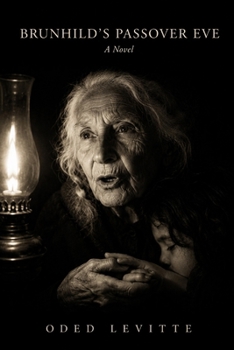
Brunhild's Passover Eve

On a Baltic island called Eriks , nine hundred people have practiced Judaism in complete isolation for three thousand years.
They have never seen Jerusalem. They have never held a Torah scroll. Their prayers are in a creole no rabbi has heard, their script a fusion of Hebrew and Norse runes carved into pine wood, their Passover seder served with salt herring and barley flatbread baked with juniper. But every morning they face east. Every year they burn the leaven and say the ancient words. Every seder they open the door and call the prophet home.
They remember everything they were given. They have forgotten what they lost.
Brunhild Davidsdotter is the berakhvinna - the practical woman who holds the community together. She bakes the flatbread, tends the aging matriarch who carries the oral tradition, and manages the quiet negotiations of a world that is entirely sufficient and entirely closed. She is also the woman who argued for what is coming: three visitors arriving by boat from the mainland - an Israeli historian, a rabbi, and a young photographer - who have heard that something extraordinary exists on this island and want to see it for themselves.
For one Passover Eve, two worlds meet across three thousand years of separation.
What unfolds is not a confrontation but a recognition - quiet, precise, and devastating. A rabbi weeps at hearing the kol chamira spoken by women who have never studied Talmud. A matriarch asks whether the Temple still stands. A girl shows a photographer the wooden wall her people have always faced east toward, and he tells her what stands in Jerusalem, and she says: we have a wall too. But it's made of wood.
And Brunhild, who carries the tradition and must decide what to do with the door now that the world has found it, stands at the threshold of the Gudhus at the end of Passover and asks herself the question the novel has been quietly building toward: whether a tradition that survived ice and silence and centuries underground can survive the harder thing - connection.
Brunhild's Passover Eve is a novel about what endures, what gets lost in the keeping, and what it means to be found after three thousand years of facing the right direction. Readers of Geraldine Brooks, Dara Horn, and A.S. Byatt will recognize the territory - meticulous historical imagination, emotional precision, and a final image that does not resolve so much as open.
The door has been open since the seder. Brunhild leaves it that way.
Customer Reviews
ThriftBooks ® and the ThriftBooks ® logo are registered trademarks of Thrift Books Global, LLC
