


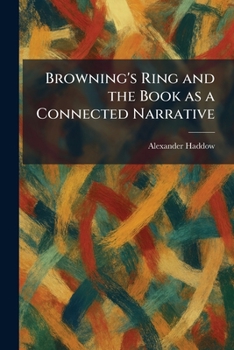
Browning's Ring and the Book as a Connected Narrative

"Browning's Ring and the Book as a Connected Narrative" offers a comprehensive and insightful examination of Robert Browning's magnum opus, one of the most ambitious and celebrated works of Victorian literature. Alexander Haddow provides readers with a lucid guide through the intricate structure of the original poem, which is famously told through multiple, often conflicting, perspectives. By synthesizing the complex legal and personal accounts of a seventeenth-century Roman murder trial, Haddow reconstructs the story into a cohesive narrative arc, making the psychological depth and moral complexity of Browning's masterpiece more accessible to scholars and poetry enthusiasts alike.
The work serves as both a scholarly commentary and a narrative companion, illuminating the themes of truth, perception, and justice that define "The Ring and the Book". Haddow's analysis explores the distinct voices of the characters-from the villainous Count Guido Franceschini to the saintly Pompilia and the contemplative Pope-while highlighting Browning's innovative use of the dramatic monologue. This volume is an essential resource for those seeking to fully appreciate the brilliance of Browning's poetic technique and the enduring power of his storytelling.
This work has been selected by scholars as being culturally important, and is part of the knowledge base of civilization as we know it. This work was reproduced from the original artifact, and remains as true to the original work as possible. Therefore, you may see the original copyright references, library stamps (as most of these works have been housed in our most important libraries around the world), and other notations in the work.
This work is in the public domain in the United States of America, and possibly other nations. Within the United States, you may freely copy and distribute this work, as no entity (individual or corporate) has a copyright on the body of the work.
As a reproduction of a historical artifact, this work may contain missing or blurred pages, poor pictures, errant marks, etc. Scholars believe, and we concur, that this work is important enough to be preserved, reproduced, and made generally available to the public. We appreciate your support of the preservation process, and thank you for being an important part of keeping this knowledge alive and relevant.
Customer Reviews
ThriftBooks ® and the ThriftBooks ® logo are registered trademarks of Thrift Books Global, LLC
