


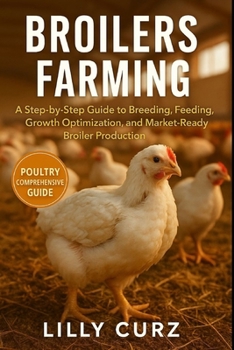
Broilers Farming: A Step-by-Step Guide to Breeding, Feeding, Growth Optimization, and Market-Ready Broiler Production.
No Customer Reviews

The broiler cycle is a coordinated sequence that transforms day-old chicks into marketable birds while protecting health, welfare, and meat quality. The stages below describe a standard deep-litter operation; cage and slatted-floor systems adapt similar principles with different hardware and densities.
Pre-Placement Preparation (7-10 days before chick arrival)Downtime and cleaning: Remove all birds and organic matter. Dry-clean floors and equipment; wash with detergent; apply approved disinfectants at correct dilutions; allow adequate drying time.Litter management: Remove caked litter. In cold or wet seasons, consider fresh litter (e.g., wood shavings, rice hulls) at 5-10 cm depth; in drier seasons, some reuse practices incorporate windrowing and reconditioning, following veterinary guidance.Equipment service: Inspect brooders, heaters, fans, inlets, curtains, lights, feeders, and drinkers. Replace worn parts. Check gas lines and safety cut-offs.Biosecurity perimeter: Repair fencing, footbaths, and entry signage; establish clean/dirty lines and visitor logs.Preheating: Warm the house 24-48 hours before placement to achieve proper floor temperature (often 30-32 C measured at litter level for chicks). Preheat water lines to avoid cold shock.Chick Placement and Brooding (Day 0-14)Chick reception: Verify chick quality-navel healing, uniform size, responsive behavior. Record delivery conditions and box counts.Brooding temperature and humidity: Start around 32-34 C air temperature (or follow strain-specific guidelines) with a focus on floor temperature and chick behavior. Gradually reduce temperature by 2-3 C per week. Relative humidity of 50-70% supports respiratory health and reduces dehydration.Lighting: Provide bright, uniform light in the first days to stimulate feed and water intake; later, implement a dark period to support leg and metabolic health.Feed and water access: Place starter feed on trays and ensure line feeders are filled. Provide abundant drinker space; adjust nipples/drinkers to chick height.Early-life vaccinations: Depending on regional disease risk, programs may include vaccinations for Newcastle disease and infectious bursal disease, among others.Observation: Chick distribution is the best thermometer-huddling under heat indicates cold; moving to wall edges suggests heat stress; clustering at drinkers suggests thirst; uniform spreading indicates comfort.
Pre-Placement Preparation (7-10 days before chick arrival)Downtime and cleaning: Remove all birds and organic matter. Dry-clean floors and equipment; wash with detergent; apply approved disinfectants at correct dilutions; allow adequate drying time.Litter management: Remove caked litter. In cold or wet seasons, consider fresh litter (e.g., wood shavings, rice hulls) at 5-10 cm depth; in drier seasons, some reuse practices incorporate windrowing and reconditioning, following veterinary guidance.Equipment service: Inspect brooders, heaters, fans, inlets, curtains, lights, feeders, and drinkers. Replace worn parts. Check gas lines and safety cut-offs.Biosecurity perimeter: Repair fencing, footbaths, and entry signage; establish clean/dirty lines and visitor logs.Preheating: Warm the house 24-48 hours before placement to achieve proper floor temperature (often 30-32 C measured at litter level for chicks). Preheat water lines to avoid cold shock.Chick Placement and Brooding (Day 0-14)Chick reception: Verify chick quality-navel healing, uniform size, responsive behavior. Record delivery conditions and box counts.Brooding temperature and humidity: Start around 32-34 C air temperature (or follow strain-specific guidelines) with a focus on floor temperature and chick behavior. Gradually reduce temperature by 2-3 C per week. Relative humidity of 50-70% supports respiratory health and reduces dehydration.Lighting: Provide bright, uniform light in the first days to stimulate feed and water intake; later, implement a dark period to support leg and metabolic health.Feed and water access: Place starter feed on trays and ensure line feeders are filled. Provide abundant drinker space; adjust nipples/drinkers to chick height.Early-life vaccinations: Depending on regional disease risk, programs may include vaccinations for Newcastle disease and infectious bursal disease, among others.Observation: Chick distribution is the best thermometer-huddling under heat indicates cold; moving to wall edges suggests heat stress; clustering at drinkers suggests thirst; uniform spreading indicates comfort.
Format:Paperback
Language:English
ISBN:B0G1DZD4Z6
ISBN13:9798273173453
Release Date:November 2025
Publisher:Independently Published
Length:254 Pages
Weight:0.76 lbs.
Dimensions:0.5" x 6.0" x 9.0"
Related Subjects
NatureCustomer Reviews
0 rating
Copyright © 2026 Thriftbooks.com
Terms of Use | Privacy Policy | Do Not Sell/Share My Personal Information | Cookie Policy | Cookie Preferences | Accessibility Statement
ThriftBooks ® and the ThriftBooks ® logo are registered trademarks of Thrift Books Global, LLC
ThriftBooks ® and the ThriftBooks ® logo are registered trademarks of Thrift Books Global, LLC
