


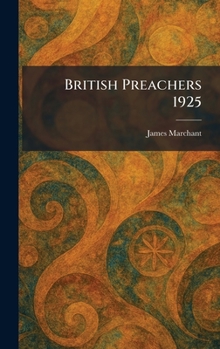
British Preachers 1925

"British Preachers 1925" is a significant collection of sermons and addresses delivered by the most distinguished voices of the British pulpit during the early twentieth century. Compiled and edited by Sir James Marchant, this volume serves as a representative cross-section of the religious thought and rhetorical excellence that defined the era.
The work brings together a diverse group of theologians and ministers, providing readers with a rich tapestry of spiritual guidance, moral philosophy, and biblical interpretation. Each entry reflects the unique theological perspective and homiletic style of its author, capturing the intellectual and spiritual atmosphere of a Britain navigating the complexities of the post-war world. From profound theological treatises to practical exhortations for daily living, these sermons offer a timeless exploration of faith and its application to the human condition.
This volume is an invaluable resource for students of homiletics, church history, and British social history, offering a direct window into the pulpit traditions that shaped public discourse and personal faith in 1925. By preserving the words of prominent 20th-century religious figures, the book provides essential context for understanding the development of modern Christian thought.
This work has been selected by scholars as being culturally important, and is part of the knowledge base of civilization as we know it. This work was reproduced from the original artifact, and remains as true to the original work as possible. Therefore, you may see the original copyright references, library stamps (as most of these works have been housed in our most important libraries around the world), and other notations in the work.
This work is in the public domain in the United States of America, and possibly other nations. Within the United States, you may freely copy and distribute this work, as no entity (individual or corporate) has a copyright on the body of the work.
As a reproduction of a historical artifact, this work may contain missing or blurred pages, poor pictures, errant marks, etc. Scholars believe, and we concur, that this work is important enough to be preserved, reproduced, and made generally available to the public. We appreciate your support of the preservation process, and thank you for being an important part of keeping this knowledge alive and relevant.
Customer Reviews
ThriftBooks ® and the ThriftBooks ® logo are registered trademarks of Thrift Books Global, LLC
