


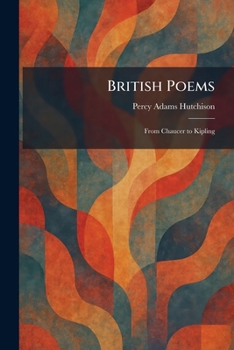
British Poems: From Chaucer to Kipling

"British Poems, From Chaucer to Kipling" is a comprehensive anthology that showcases the extraordinary breadth and depth of the British poetic tradition. Edited by Percy Adams Hutchison, this collection spans several centuries of literary history, providing a chronological survey of the masters of the English language. From the foundational Middle English verses of Geoffrey Chaucer to the late-Victorian and Edwardian works of Rudyard Kipling, the volume offers a curated journey through the evolution of poetic form, style, and sentiment.
The collection includes pivotal works from the Renaissance, the Enlightenment, the Romantic movement, and the Victorian era, allowing readers to trace the shifting cultural and intellectual landscapes of the British Isles. Included are essential voices that have defined the canon, illustrating the development of the sonnet, the epic, the lyric, and the ballad. As a significant record of literary heritage, "British Poems, From Chaucer to Kipling" serves as both an invaluable resource for students of literature and a timeless treasury for any lover of classic verse. This work highlights the enduring power of British poetry to capture the human experience across generations.
This work has been selected by scholars as being culturally important, and is part of the knowledge base of civilization as we know it. This work was reproduced from the original artifact, and remains as true to the original work as possible. Therefore, you may see the original copyright references, library stamps (as most of these works have been housed in our most important libraries around the world), and other notations in the work.
This work is in the public domain in the United States of America, and possibly other nations. Within the United States, you may freely copy and distribute this work, as no entity (individual or corporate) has a copyright on the body of the work.
As a reproduction of a historical artifact, this work may contain missing or blurred pages, poor pictures, errant marks, etc. Scholars believe, and we concur, that this work is important enough to be preserved, reproduced, and made generally available to the public. We appreciate your support of the preservation process, and thank you for being an important part of keeping this knowledge alive and relevant.
Customer Reviews
ThriftBooks ® and the ThriftBooks ® logo are registered trademarks of Thrift Books Global, LLC
