


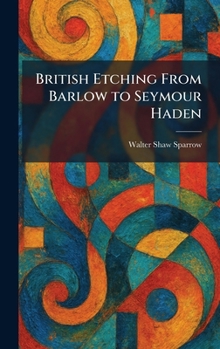
British Etching From Barlow to Seymour Haden

"British Etching From Barlow to Seymour Haden" offers a definitive survey of the art of etching in Great Britain, tracing its evolution from the early mastery of Francis Barlow in the seventeenth century to the influential works of Francis Seymour Haden in the late nineteenth century. Authored by the noted art critic Walter Shaw Sparrow, this work provides an in-depth analysis of the stylistic shifts and technical innovations that defined the British school of printmaking.
The text examines the contributions of numerous artists who elevated etching from a commercial reproductive tool to a respected form of fine art. Sparrow delves into the aesthetic qualities of individual plates, the social contexts that influenced subject matter, and the revival of the medium during the Victorian era. Readers will find detailed discussions on the "Etching Revival" and the significant impact of key figures who shaped the British landscape and portrait traditions through the needle and copper plate.
This volume serves as an essential resource for art historians, collectors, and enthusiasts of graphic arts. It celebrates the intricate beauty of the etched line and captures a vital era of British artistic achievement, documenting the transition of a craft into a sophisticated medium of personal expression.
This work has been selected by scholars as being culturally important, and is part of the knowledge base of civilization as we know it. This work was reproduced from the original artifact, and remains as true to the original work as possible. Therefore, you may see the original copyright references, library stamps (as most of these works have been housed in our most important libraries around the world), and other notations in the work.
This work is in the public domain in the United States of America, and possibly other nations. Within the United States, you may freely copy and distribute this work, as no entity (individual or corporate) has a copyright on the body of the work.
As a reproduction of a historical artifact, this work may contain missing or blurred pages, poor pictures, errant marks, etc. Scholars believe, and we concur, that this work is important enough to be preserved, reproduced, and made generally available to the public. We appreciate your support of the preservation process, and thank you for being an important part of keeping this knowledge alive and relevant.
Customer Reviews
ThriftBooks ® and the ThriftBooks ® logo are registered trademarks of Thrift Books Global, LLC
