


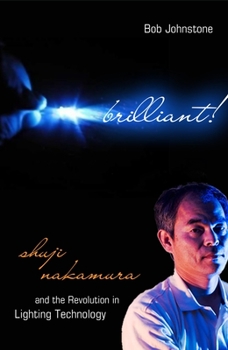
Brilliant!: Shuji Nakamura And the Revolution in Lighting Technology

A revolution in the way we use artificial lighting is underway, one that is every bit as sweeping and significant as Edison's invention of the light bulb. The technology of light emitting diodes... This description may be from another edition of this product.
Format:Hardcover
Language:English
ISBN:1591024625
ISBN13:9781591024620
Release Date:April 2007
Publisher:Prometheus Books
Length:336 Pages
Weight:1.36 lbs.
Dimensions:9.3" x 0.9" x 6.3"
Customer Reviews
5 ratings
Best Book on LED technology
Published by Thriftbooks.com User , 16 years ago
Many people have said that energy conservation is the key to weaning ourselves of foreign oil and dirty coal but how do we do it? This book not only gives you the fascinating story behind the development of the blue LED but also provides a path to help us conserve energy. I would especially recommend this book to anybody who is thinking of starting a green business in 2009 or beyond.
Exclusive interviews with a brilliant inventor
Published by Thriftbooks.com User , 17 years ago
Shuji Nakamura worked virtually alone at a small Japanese company in 1992 when he developed the bright blue light-emitting diode, or LED, that may supplant the electric light bulb in home and commercial applications. He was employed by Nichia Chemical Industries in Anan on Japan's southern island of Shikoku. Nichia invested over $1 million in Nakamura's research on indium-gallium-nitride, a compound-semiconductor alloy most other researchers had dismissed as useless for LED manufacturing because of its many defects. Nakamura modified standard chemical vapor-deposition equipment to achieve the uniform, nanometers-thin layers needed to emit copious blue light. As Johnstone writes: "100 times brighter than commercial silicon-carbide blue LEDs, bright enough to be seen in broad daylight." (Thus, Brilliant!) Nakamura became a celebrity in Japan. Cree Research, Durham, N.C., the market leader in silicon-carbide blue LEDs, tried to make an alliance with Nichia. When it was rebuffed by Nichia, it tried to hire Nakamura. Nakamura remained loyal to Nichia, and turned out ever brighter and more versatile diodes. By increasing the indium content, for example, he achieved bright green LEDs, and in 1996 he announced the first blue-violet laser diode. The blue emitting diode is essential to generate bright white light. Red and green light combined in the proper proportions with blue light yields white light. The red and green can come either from other LEDs or from the blue LED itself, using phosphors to convert part of its output to lower-frequency light. LEDs have surpassed incandescent and halogen bulbs in lumens per watt, and reached the levels that only the best fluorescent tubes can attain. Their lifetimes run from 50,000 to 100,000 hours. In widespread use, they could achieve enormous cost savings. A shift to solid-state lighting would also enormously reduce production of greenhouse gases. Johnstone describes some of the key players in a solid-state lighting industry that grosses $4 billion a year, and promises to grow quickly. Nichia, Cree, Color Kinetics of Boston, Permlight Products of Tustin, Calif., and Carmanah Technologies Corp., in Victoria, B.C., Canada, may be significant players. Johnstone doesn't discuss Royal Philips Electronics, in Amsterdam, which has great researchers, and enormous marketing and manufacturing capabilities. Johnstone closes the book with Nakamura in 1999 when Nakamura accepts a tenured position as the Cree Professor of Solid State Lighting and Display at the University of California, Santa Barbara. Before he can start his reseraches, Nichia sued him for leaking trade secrets to Cree. Nakamura counter-sued for profits; the case was heard at Japan's highest court amid wide-spread publicity; and it was settled in the early 2005. Nakamura won the 2006 Millennium Technology Prize and Johnstone suggests that Nakamura may ultimately win a Nobel Prize for his work. Johnstone is a true believer; he thinks that solid state lig
Any science library strong in invention history needs BRILLIANT!
Published by Thriftbooks.com User , 18 years ago
BRILLIANT! SHUJI NAKAMURA AND THE REVOLUTION IN LIGHTING TECHNOLOGY tells of the evolution of LED technology and how it was stalled over making an LED that would emit the bright blue light needed to make useful white light LEDs - until researcher Shuji Nakamura's key invention which single-handedly created the industry of solid-state lighting. Author Bob Johnstone is the first Western journalist to meet and interview Nakamura, and here provides a powerful blend of science and biography to show how the inventor made his ground-breaking discovery and how LEDs are revolutionizing the world. Any science library strong in invention history needs BRILLIANT! Diane C. Donovan California Bookwatch
Must read book on Nakamura and LEDs
Published by Thriftbooks.com User , 18 years ago
I heartily recommend this book for people who are interested in innovation, business, science, technology, etc. The book tells the fascinating story of Nakamura and the impact LEDs are having on the lighting industry. Part One of the book tells the story of how Nakamura invented the first commercially successful GaN LED. Part Three explains how Nakamura became unwanted at Nichia and how he decided to move to UCSB. Parts Two and Four talk about some of the companies that are using LEDs to make exciting new products. I'll be a nit picker and say the book should be titled "Shuji Nakamura and the *Coming* revolution in Lighting Technology" because the revolution is just starting. Although LEDs have been around for about four decades and everyone already owns products that incororate them, very few people understand the potential of LEDs and the impact that they will have on lighting over the next few years. The conversion to white LEDs for general lighting is underway. People will want to understand more about this phenomenon as they recognize the impact that LEDs are having on the lighting industry and energy consumption. The good news is that this book will serve as a tutorial for people who want to learn about LEDs.
A MUST READ for environmentalists and investors!!
Published by Thriftbooks.com User , 18 years ago
Brilliant!!! Refreshing!!! Bob Johnstone is correct in espousing Shuji Nakamura as the leader of the LED revolution. Shuji's list of patents and accomplishments in his field far outshine all of his peers put together. Definitely a Nobel Prize in the works for Mr. Nakamura and hopefully a Pulitzer for Mr. Johnstone for his ability to explain this complex subject to the average reader in a true tale of high intrigue! The LED scientific community is still rather small. The competition for the holy grail (replacing the everyday lightbulb) is phenomenal. Bob and Shuji have this unusual, provocative combination that tells the story of this new high tech race. Bob spends quite a few chapters explaining the unusual and life changing ramifications of LED development worlwide. A must read for any investor or those with eco-green concerns!!!
Copyright © 2026 Thriftbooks.com Terms of Use
| Privacy Policy | Do Not
Sell/Share My Personal Information | Cookie Policy | Cookie Preferences | Accessibility Statement
ThriftBooks® and the ThriftBooks® logo are registered trademarks of Thrift Books Global, LLC
ThriftBooks® and the ThriftBooks® logo are registered trademarks of Thrift Books Global, LLC
