


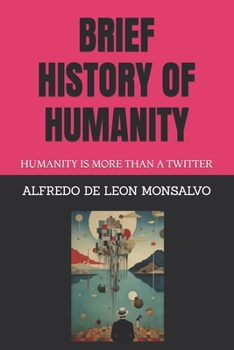
Brief History of Humanity: Humanity Is More Than a Twitter

Humanity's journey began in Africa, where Homo sapiens evolved around 300,000 years ago. From there, humans spread across the globe, surviving and adapting through hunting, gathering, and the gradual development of language and tools.
Around 10,000 years ago, the Neolithic Revolution transformed our way of life. Humans began farming, domesticating animals, and forming permanent settlements. Civilizations emerged in river valleys like the Nile, Tigris-Euphrates, Indus, and Yellow River, giving birth to writing, laws, religion, and centralized power.
The classical civilizations-Greece, Rome, Persia, India, and China-brought philosophy, science, art, and the concept of democracy. At the same time, major world religions like Hinduism, Buddhism, Judaism, Christianity, and Islam shaped moral and social systems that still endure today.
After the fall of the Roman Empire, medieval societies in Europe were dominated by feudalism and the Catholic Church, while Islamic, African, and Asian civilizations thrived in trade, culture, and scientific discovery.
The Renaissance in Europe reawakened interest in reason, art, and science. It was followed by the Age of Exploration, where European powers colonized much of the world, initiating centuries of conquest, exploitation, and cultural exchange-often violent and unequal.
The Industrial Revolution in the 18th and 19th centuries revolutionized technology, urban life, and global economies, but also deepened social inequality and imperial competition. These tensions contributed to the World Wars of the 20th century, along with revolutions, decolonization, and the rise of ideologies like fascism, communism, and liberal democracy.
Today, humanity faces global challenges: climate change, inequality, artificial intelligence, war, and pandemics. But we also have unprecedented tools for communication, cooperation, and transformation.
From primitive tribes to digital societies, the story of humanity is one of survival, imagination, and the constant struggle between domination and freedom, ignorance and knowledge, fear and hope.
Related Subjects
HistoryCustomer Reviews
ThriftBooks ® and the ThriftBooks ® logo are registered trademarks of Thrift Books Global, LLC
