


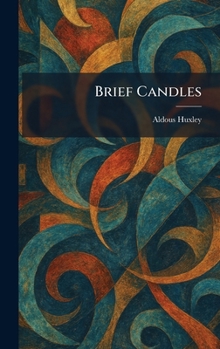
Brief Candles

Select Format
Select Condition 
Book Overview
"Brief Candles" is a compelling collection of short fiction by Aldous Huxley, showcasing the author's sharp wit and profound insight into the human condition. Comprising three short stories-"Chawdron," "The Rest Cure," and "The Claxtons"-alongside the celebrated novella "After the Fireworks," this collection offers a biting satire of the social and intellectual circles of the early 20th century. Huxley explores themes of vanity, self-delusion, and the intricate complexities of human relationships with his characteristic irony and intellectual depth.
Each narrative in the collection serves to dismantle the pretenses of its characters, from the tragicomedy of a businessman's infatuation to the stifling psychological atmosphere of a forced convalescence. The centerpiece, "After the Fireworks," delves into the intense and often destructive dynamics between an aging novelist and a young admirer, providing a nuanced examination of desire and the passage of time. These stories capture the transition between the fading Victorian era and the rise of modernism, reflecting the cynicism and spiritual searching of a generation caught between two worlds. "Brief Candles" remains a significant work in the Huxley canon, illustrating his evolution as a writer and his enduring ability to critique the follies of society.
This work has been selected by scholars as being culturally important, and is part of the knowledge base of civilization as we know it. This work was reproduced from the original artifact, and remains as true to the original work as possible. Therefore, you may see the original copyright references, library stamps (as most of these works have been housed in our most important libraries around the world), and other notations in the work.
This work is in the public domain in the United States of America, and possibly other nations. Within the United States, you may freely copy and distribute this work, as no entity (individual or corporate) has a copyright on the body of the work.
As a reproduction of a historical artifact, this work may contain missing or blurred pages, poor pictures, errant marks, etc. Scholars believe, and we concur, that this work is important enough to be preserved, reproduced, and made generally available to the public. We appreciate your support of the preservation process, and thank you for being an important part of keeping this knowledge alive and relevant.
Customer Reviews
ThriftBooks ® and the ThriftBooks ® logo are registered trademarks of Thrift Books Global, LLC
