


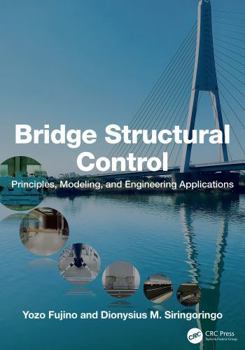
Bridge Structural Control: Principles, Modeling and Engineering Applications

Large-amplitude vibrations raise two major concerns in structural design: safety and serviceability. Their suppression through vibration control is therefore essential. This need is particularly critical in bridge engineering, where structures are continuously exposed to dynamic excitations from traffic, wind, earthquakes, and pedestrian activities. Driven by the increasing span lengths and flexibility of modern bridges, numerous vibration-control concepts and technologies have been developed. The primary objective of bridge vibration control is to ensure structural safety, maintain serviceability, and achieve reliable performance throughout the design life without compromising economy.
The book addresses bridge vibration-control strategies, from fundamental principles and modeling to practical engineering applications and technologies. The content is summarized from research conducted by the authors and their research groups and also recent contributions from leading scholars to reflect the latest advances in the field. It covers passive, semi-active, hybrid, and active control systems, with detailed discussions of widely used techniques such as passive dampers, tuned mass dampers, tuned liquid dampers, active mass damper, hybrid mass damper and seismic isolation systems. Real-world case studies are presented throughout to illustrate vibration phenomena in various bridge types and the implementation of effective control strategies.
Introduction to Bridge Structural Control Energy Dissipation Devices for Passive Control of Bridge Vibration Tuned Mass Dampers for Control of Bridge Vibration Tuned Liquid Dampers for Control of Bridge Vibration Seismic Isolation for Passive Control of Bridge Vibration Passive Control of Wind-Induced Bridge Vibration by Aerodynamic Modifications Hybrid and Semi-Active Controls of Bridge Vibration Semi-Active Controls of Bridge Vibration Active Control Systems for Bridge Vibration Vibration and Control of Cable in Cable-Supported BridgeCustomer Reviews
ThriftBooks ® and the ThriftBooks ® logo are registered trademarks of Thrift Books Global, LLC
