


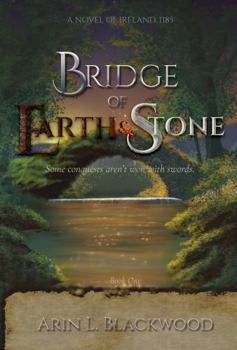
Bridge of Earth & Stone

Between the earth that raised her and the conquest built in stone, only one bridge can hold them both.
Ireland, 1185. Fourteen years after her father rode out to fight the Normans and never came home, Alva NicAonghusa holds his land with her own two hands. She works the fields, pays her rents to the new lords, and trusts no one who speaks their tongue. Her walls are high, and they have kept her and her younger sister alive.
Then Aase vanishes from the Dublin market.
Prince John is coming with his bright banners, the city is thick with strangers, and a holding left without its keeper can be struck from the roll and handed to another. To search for her sister without losing everything their father built, Alva must do the one thing she swore she never would: stand before her Norman lord and ask for his help.
Sir Alastair Walsh is half Welsh and half Norman, a knight who belongs fully to neither of the peoples that made him. He has come to Ireland to hold land for a lord, not to untangle the grief of the people who work it. He is sharp, proud, and far less blind to the old Irish law than Alva expects. When she offers him a bargain bound by Gaelic custom, he sees what she is risking, and what he might gain by accepting.
Their search carries them from the quays and back lanes of Dublin into the fault lines of a conquest that is still being fought, where Gaelic custom and Norman law, old loyalties and new lords, pull against each other at every turn. The deeper they go, the clearer it becomes that the past Alva thought she understood is not the whole story.
Told in two voices and alive with Irish, Norse, and Norman French, Bridge of Earth and Stone is a historical novel of grief, loyalty, and survival in a land being remade by conquest, with a slow-burning thread of something neither Alva nor Alastair is ready to name. It draws on real people, places, and the texture of everyday life in twelfth-century Ireland, from peat smoke and souterrains to Brehon law and the ambitions of a young prince.
Written by an archaeologist who spent nearly a decade studying medieval Ireland on the ground, it offers the real Ireland of the Anglo-Norman conquest rather than the postcard version.
Perfect for readers of Diana Gabaldon's Outlander, Ken Follett's The Pillars of the Earth, and Susanna Kearsley's The Winter Sea.
Customer Reviews
ThriftBooks ® and the ThriftBooks ® logo are registered trademarks of Thrift Books Global, LLC
