


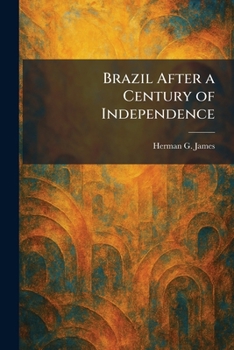
Brazil After a Century of Independence

Select Format
Select Condition 
Book Overview
"Brazil After a Century of Independence" offers a comprehensive and insightful survey of the largest nation in South America at a pivotal moment in its development. Written by Herman G. James following the centennial of Brazil's independence from Portugal, this work provides an in-depth analysis of the country's historical evolution, political institutions, and socio-economic progress up to the mid-1920s.
The book explores the intricate tapestry of Brazilian life, covering its transition from a monarchy to a republic, the challenges of its vast geography, and its emerging role in the global economy. Readers will find detailed observations on Brazil's resources, including its dominant coffee industry, as well as its cultural diversity and the administrative structures that defined the nation during this era. James combines academic rigor with firsthand observations, making this a vital resource for scholars of history and those interested in the foundational years of modern South America.
As a snapshot of a nation reflecting on its first hundred years of self-governance, "Brazil After a Century of Independence" remains a significant historical document. It captures the aspirations and growing pains of a country striving for modernization and international recognition, providing valuable context for understanding the trajectory of contemporary Brazil.
This work has been selected by scholars as being culturally important, and is part of the knowledge base of civilization as we know it. This work was reproduced from the original artifact, and remains as true to the original work as possible. Therefore, you may see the original copyright references, library stamps (as most of these works have been housed in our most important libraries around the world), and other notations in the work.
This work is in the public domain in the United States of America, and possibly other nations. Within the United States, you may freely copy and distribute this work, as no entity (individual or corporate) has a copyright on the body of the work.
As a reproduction of a historical artifact, this work may contain missing or blurred pages, poor pictures, errant marks, etc. Scholars believe, and we concur, that this work is important enough to be preserved, reproduced, and made generally available to the public. We appreciate your support of the preservation process, and thank you for being an important part of keeping this knowledge alive and relevant.
Related Subjects
History Political Science Politics & Social Sciences Social Science Social SciencesCustomer Reviews
ThriftBooks ® and the ThriftBooks ® logo are registered trademarks of Thrift Books Global, LLC
