


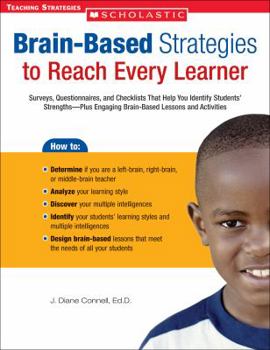
Brain-Based Strategies to Reach Every Learner : Surveys, Questionnaires, and Checklists That Help You Identify Students' Strengths-Plus Engaging Brain-Based Lessons and Activities


Select Format
Select Condition 
Book Overview
An indispensable guide to brain-based learning. Diane Connell summarizes current brain research and discusses the implications for the classroom. She offers tools to identify learning styles and ideas... This description may be from another edition of this product.
Format:Paperback
Language:English
ISBN:0439590205
ISBN13:9780439590204
Release Date:August 2005
Publisher:Scholastic, Incorporated
Length:160 Pages
Weight:0.08 lbs.
Dimensions:0.3" x 8.4" x 10.9"
Age Range:6 to 11 years
Grade Range:Grades 1 to 6
Customer Reviews
2 ratings
A Great Resource!!
Published by Thriftbooks.com User , 18 years ago
Diane Connell's "Brain-Based Strategies To Reach Every Learner" is a great resource for teachers AND parents! As a primary school teacher for 20 years, and now currently working as a consultant in schools with parents,students and teachers on how to switch students on to learn in a way that makes sense to them, I can highly recommend this book. Crammed full of really useful information - and presented in a style that makes sense - you don't have to be a teacher to understand the message that we all learn in different ways... and that learning can be fun! For teachers there are so many great tips and ideas which can be easily implemented in the classroom and for parents who want to find out what makes their child 'tick', this book is a real revelation. A top read - well done Diane!
A good resource for teachers
Published by Thriftbooks.com User , 19 years ago
"Brain Based Strategies to Reach Every Learner" by Diane Connell, Ed.D. is a worthwhile resource for teachers who want an overview of the principles of some important psychological theories and how they apply to lesson plans in the classroom. For example, the book offers strategies for visual, auditory, and kinesthetic learners and the importance of using lesson plans that reach each type of student. Other ideas include memory strategies. Often children may be asked to simply memorize information (e.g. the 50 states), but may have difficulty simply memorizing or may forget the information after a short time. The book offers some excellent ideas (based on memory research) to help a child to put information into long-term memory from working memory. Other topics include Gardner's nine factor theory of intelligence. Once again, it describes Gardner's theory (which is an excellent one by the way), and offers suggestions in the classroom to reach kids with various strengths (e.g. musical intelligence) which are not consistently measured in traditional school curriculums on a consistent basis. The book begins with basic brain anatomy and discussion of left and right brained learners. The reader will probably find some new ideas to apply to lesson plans and in using these ideas may be able to reach more nontraditional learners.
Copyright © 2026 Thriftbooks.com
Terms of Use | Privacy Policy | Do Not Sell/Share My Personal Information | Cookie Policy | Cookie Preferences | Accessibility Statement
ThriftBooks ® and the ThriftBooks ® logo are registered trademarks of Thrift Books Global, LLC
ThriftBooks ® and the ThriftBooks ® logo are registered trademarks of Thrift Books Global, LLC
