


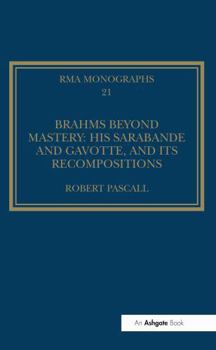
Brahms Beyond Mastery: His Sarabande and Gavotte, and Its Recompositions
No Customer Reviews

In 1853 Robert Schumann identified fully-formed compositional mastery in the young Brahms, who nevertheless in the years following embarked on a period of intensive further study, producing, among other works, the neo-baroque Sarabande and Gavotte. These dances have not been properly recognized as constituting a distinct Brahms work before now, but manuscript evidence and their performance history indicate that Brahms and his friends thought of them as such in the mid-1850s, when they became the first music of his performed publicly in Gdansk, Vienna, Budapest and London. He later suppressed the dances, using them instead as a thematic quarry for three chamber music masterpieces, from different stages in his life and in distinctly different ways: the Second String Sextet, the First String Quintet and the Clarinet Quintet. This book gives an account of the compositional and performance history, stylistic features and re-uses of the dances, setting these in the wider context of Brahms's developing creative concerns and trajectory. It constitutes therefore a study of a 'lost' work, of how a fully-formed master opens himself to 'the in-flowing from afar' (in Martin Heidegger's terms), and of the transformative reach and concomitant expressive richness of Brahms's creative thought.
Format:Paperback
Language:English
ISBN:1032930896
ISBN13:9781032930893
Release Date:October 2024
Publisher:Routledge
Length:120 Pages
Customer Reviews
0 rating
Copyright © 2026 Thriftbooks.com Terms of Use
| Privacy Policy | Do Not
Sell/Share My Personal Information | Cookie Policy | Cookie Preferences | Accessibility Statement
ThriftBooks® and the ThriftBooks® logo are registered trademarks of Thrift Books Global, LLC
ThriftBooks® and the ThriftBooks® logo are registered trademarks of Thrift Books Global, LLC
