


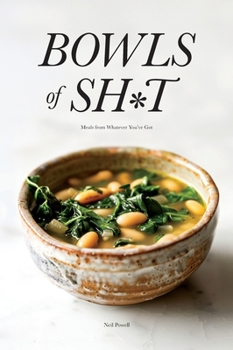
Bowls of Shit

Bowls of Shit is not a cookbook about perfect meals. It is a book about what happens when you stop trying to make them.
These are bowls made from what is already there. A handful of pasta. A can of beans. An egg, some rice, a piece of bread, something left in the pan. The kinds of ingredients that remain after the plan has fallen apart-or never existed in the first place. Nothing here depends on precision, timing, or special equipment. The point is not to improve the food. The point is to recognize when it is already enough.
Each spread is structured simply: what you need, what you do, and the result. The instructions are direct and minimal, written to be followed without thinking too hard about them. There are no techniques to master and no outcomes to perfect. Small adjustments are allowed. Substitutions are expected. If something is missing, something else takes its place.
The meals themselves are quiet. Pasta with butter and pepper. Rice with egg and soy. Beans with greens. Potatoes with fat. Broth with bread. They are built from combinations that have existed for a long time, not because they are impressive, but because they work. They come together quickly, often in a single pan, and they hold up under repetition.
This book is not concerned with plating, presentation, or variation for its own sake. The photographs show the bowls as they are: close, direct, and without styling. What matters is not how the food looks at a distance, but how it feels when it is in front of you-warm, soft, salty, sharp, filling.
Bowls of Shit uses a phrase that is meant to be understood, not explained. It refers to the moment when you look at what you have and assume it is not much. This book suggests otherwise. It treats those ingredients with a kind of seriousness, not by elevating them, but by leaving them alone.
Over time, the repetition becomes the point. The same few ingredients appear again and again in different combinations. You begin to recognize patterns. You learn how far things can stretch, what holds together, what can be added, and what can be left out. The system reveals itself through use, not instruction.
This is a book for people who cook without a plan, who eat late, who work with what is left, and who understand that a good meal does not need to announce itself. It is for anyone who has ever stood in a kitchen, looked around, and decided to make something anyway.
Not better. Just enough.
Customer Reviews
ThriftBooks ® and the ThriftBooks ® logo are registered trademarks of Thrift Books Global, LLC
