


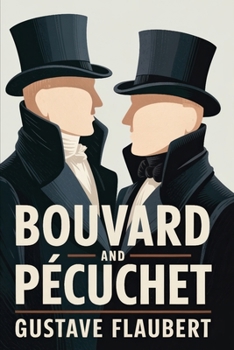
Bouvard and Pécuchet: A New Translation

Two copy-clerks. One park bench. An unlimited inheritance. A catastrophic idea.
When Bouvard and P cuchet meet on a Paris bench in 1838 and discover they have each written their name in the band of their hat, they form a friendship that will last a lifetime - and consume it entirely. Inheriting a fortune, they retire to the Norman countryside with a bold ambition: to master every field of human knowledge.
They begin with agriculture. It fails. Then chemistry. Then medicine, archaeology, history, philosophy, and religion. Each new subject is approached with identical enthusiasm; each ends in identical disaster. Crops rot. Experiments explode. Cures make patients worse. Historians contradict each other. Philosophers refute each other across centuries. And through every catastrophe, Bouvard and P cuchet press on, certain that the next chapter of human knowledge will be the one that finally yields its secrets.
Bouvard and P cuchet was the last novel Flaubert ever wrote, left unfinished at his death in 1880 and published the following year. He spent eight years on it, read over fifteen hundred books in its preparation, and called it "a kind of encyclopedia made into farce." It is also, beneath the comedy, a profound and unsettling inquiry into what human beings actually know, and whether knowledge - of any kind - is capable of saving us from ourselves.
In the tradition of Rabelais, Cervantes, and Swift. By the author of Madame Bovary.
Customer Reviews
ThriftBooks ® and the ThriftBooks ® logo are registered trademarks of Thrift Books Global, LLC
