


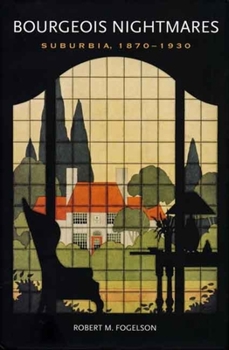
Bourgeois Nightmares: Suburbia, 1870-1930

Select Format
Select Condition 
Book Overview
An eminent urban historian uncovers the long-neglected history of the restrictive covenants that played a pivotal role in shaping America's suburbs The quintessential American suburbs, with their gracious single-family homes, large green lawns, and leaf-shaded streets, reflected not only residents' dreams but nightmares, not only hopes but fears: fear of others, of racial minorities and lowincome groups, fear of themselves, fear of the market, and, above all, fear of change. These fears, and the restrictive covenants that embodied them, are the subject of Robert M. Fogelson's fascinating new book. As Fogelson reveals, suburban subdividers attempted to cope with the deep-seated fears of unwanted change, especially the encroachment of "undesirable" people and activities, by imposing a wide range of restrictions on the lots. These restrictions ranged from mandating minimum costs and architectural styles for the houses to forbidding the owners to sell or lease their property to any member of a host of racial, ethnic, and religious groups. These restrictions, many of which are still commonly employed, tell us as much about the complexities of American society today as about its complexities a century ago.
Format:Paperback
Language:English
ISBN:B000OSJBXK
ISBN13:9780300124170
Release Date:September 2007
Publisher:Yale University Press
Length:272 Pages
Weight:0.90 lbs.
Dimensions:0.6" x 5.4" x 8.1"
Customer Reviews
1 rating
Please grade the book on what it is, not what you hoped for!!!!!!
Published by Thriftbooks.com User , 19 years ago
This book is a great introduction to the genesis of gated communities. If you do not know, that genesis lies in developer's need to earn a high rate of return for their investment. In the past, developers included many design features to attract those who would purchase the most profitable properties and homes from these developers. These features included aspects such as strict zoning within areas, design demands to protect scenic views, and requirements for landscaping. The book shows how many developers took the favored design ideas of time and made them applicable to profitable development. They bastardized many of these ideas, but by using marketing were able to obscure this fact. In the end, the author stresses the role of marketing in facilitating such development. The author does not discuss many of the purported, and debated, consequences these developments have generated. That is not the purpose of the book. There are other books covering that treatment. So the previous poster is off the mark. Way off the mark. They reference the America's continued purchase of these properties as an indication of their stupidity. This is unfounded. America desires the suburban properties because they maximize privacy which people value. They do not want to be forced to purchase many of the forms proposed by the design geniuses (Duany et al.) because these forms of design do not maximize the values desired by individuals. Yes, there are costs to this form of development. But Americans have made the decision to pay these costs so they can enjoy privacy. These are the costs of freedom. If you do not wish to pay those costs, be honest and advocate for the abolition of freedom in what type of property we can purchase. But do not cast the lack of favor for "enlightened development" of property as stupid, because that is little more than intellectual snobbery and dishonesty. In short this book is worth buying.
Copyright © 2026 Thriftbooks.com
Terms of Use | Privacy Policy | Do Not Sell/Share My Personal Information | Cookie Policy | Cookie Preferences | Accessibility Statement
ThriftBooks ® and the ThriftBooks ® logo are registered trademarks of Thrift Books Global, LLC
ThriftBooks ® and the ThriftBooks ® logo are registered trademarks of Thrift Books Global, LLC
