


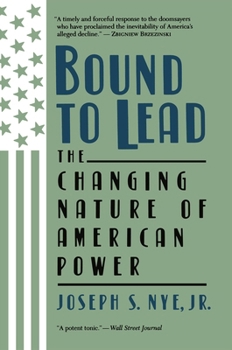
Bound to Lead: The Changing Nature of American Power

Select Format
Select Condition 
Book Overview
A pre-eminent scholar challenges the notion of inevitable American decline, arguing that the nation can still lead in a rapidly shifting world order "Nye marshals his wide grasp of history, politics, and economics to produce a compelling book." --The Economist In this pioneering work, Joseph S. Nye, Jr., reckons with the enduring claim that American decline is inevitable. He argues that the United States will remain the dominant world power and shows that narratives about decline only divert policy makers from creating effective strategies for the future. The United States is not losing power; the nature of power has simply changed. The real--and unprecedented--challenge for the United States is maintaining its position as the world becomes increasingly interdependent.
Format:Paperback
Language:English
ISBN:0465007449
ISBN13:9780465007448
Release Date:August 1991
Publisher:Basic Books
Length:336 Pages
Weight:0.65 lbs.
Dimensions:0.8" x 6.1" x 9.1"
Customer Reviews
1 rating
Nye, soft power and new challenges...
Published by Thriftbooks.com User , 22 years ago
Are the theories of decline regarding USA's power correct?. In "Bound to lead", Nye tackles that question, and many more. According to the author, USA is still the main superpower, but it will have to change its strategies if it wants to go on being one, due to the fact that the nature of power has changed.Nye distinguishes two faces of power. The first face is command or "hard power", and with it "you get other states to do what you want". The main source of "hard power" is military power. On the other hand, you have the second face of power, co- optive or "soft power", and with it "you make others want what you want". The main sources of soft power are intangible power resources like national cohesion, culture, ideology and influence on international institutions. Both faces of power are necessary, and they coexist, but soft power is becoming increasingly important as years go by. If USA wants to be able to control its political environment, and to "get other nations to do what it wants", it will need to keep that in mind, and react accordingly. In my opinion, one of the main ideas in "Bound to lead" is that in the XXI century USA won't face new challengers: it will need to deal with new challenges. A good example of those "new challenges" is the transformation of power I already mentioned: soft power is becoming essential to USA if it wants to attain its goals. It is evident that power is becoming less fungible, less coercive and less tangible. The real question is if USA will understand that, or if it will try to achieve its objectives without paying attention to the legitimacy in the eyes of other states that the second face of power can lend to its actions...Nye, who is nowadays dean of the Kennedy School for Government at Harvard University, wrote this excellent book in 1990. His main recommendation regarding USA's policy was then to invest more in soft power resources, because they help to provide co-optive behavioural power. It is relevant to highlight that that recommendation is as valid today as it was in 1990, if not more so. I believe that most people who want to know more about what is happening in the world will enjoy "Bound to lead". You don't need to know about the subject beforehand: the book is clear, and repeats some basic concepts that those who have read more about the subject already know. Notwithstanding that, this book will be interesting even for them: Nye's book is rather unpretentious, but it has a lot to contribute to their knowledge of International Relations. In this case, simplicity doesn't mean triviality. All in all I can strongly recommend this book to you. I think it is a classic, more than well worth your time and money... Belen Alcat
Copyright © 2026 Thriftbooks.com
Terms of Use | Privacy Policy | Do Not Sell/Share My Personal Information | Cookie Notice | Cookie Preferences | Accessibility Statement
ThriftBooks ® and the ThriftBooks ® logo are registered trademarks of Thrift Books Global, LLC
ThriftBooks ® and the ThriftBooks ® logo are registered trademarks of Thrift Books Global, LLC
