


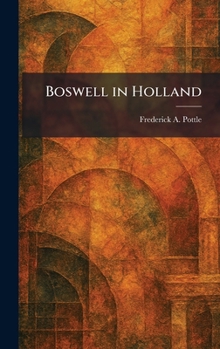
Boswell in Holland

"Boswell in Holland" offers an intimate and revelatory look into the formative years of one of literature's greatest biographers, James Boswell. Covering the period between 1763 and 1764, this collection of journals, letters, and daily memoranda documents Boswell's residence in Utrecht, where he traveled to study law and seek a more disciplined life. The work captures the internal conflict of a young man caught between his high-spirited impulses and the somber expectations of his station, providing a candid self-portrait of his struggles with melancholy and his pursuit of moral perfection.
Beyond its psychological depth, "Boswell in Holland" serves as a vivid travelogue of the 18th-century Netherlands. It details his interactions with the Dutch aristocracy, his academic pursuits, and his complex courtship of the brilliant and unconventional Belle de Zuylen. Through Boswell's observant eye, readers gain insight into the social customs, intellectual climate, and daily routines of the Enlightenment era. This volume is an essential primary source for scholars of the Georgian period and a compelling narrative for anyone interested in the personal development of the man who would eventually write the definitive biography of Samuel Johnson.
This work has been selected by scholars as being culturally important, and is part of the knowledge base of civilization as we know it. This work was reproduced from the original artifact, and remains as true to the original work as possible. Therefore, you may see the original copyright references, library stamps (as most of these works have been housed in our most important libraries around the world), and other notations in the work.
This work is in the public domain in the United States of America, and possibly other nations. Within the United States, you may freely copy and distribute this work, as no entity (individual or corporate) has a copyright on the body of the work.
As a reproduction of a historical artifact, this work may contain missing or blurred pages, poor pictures, errant marks, etc. Scholars believe, and we concur, that this work is important enough to be preserved, reproduced, and made generally available to the public. We appreciate your support of the preservation process, and thank you for being an important part of keeping this knowledge alive and relevant.
Customer Reviews
ThriftBooks ® and the ThriftBooks ® logo are registered trademarks of Thrift Books Global, LLC
