


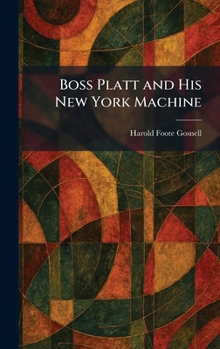
Boss Platt and His New York Machine

"Boss Platt and His New York Machine" provides a meticulous and scholarly examination of the political career of Thomas Collier Platt, one of the most powerful political bosses in American history. Through this influential study, Harold Foote Gosnell explores the intricate mechanics of the New York State Republican machine during the late nineteenth and early twentieth centuries. The work dissects how Platt, often referred to as the "Easy Boss," wielded immense influence over legislation, patronage, and elections without ever holding a major executive office.
Gosnell analyzes the organizational structure of the machine, detailing the methods used to maintain party discipline and the relationship between local organizations and state leadership. The book offers deep insights into the nature of political leadership, the evolution of party loyalty, and the complex dynamics between political bosses and reformers like Theodore Roosevelt. By documenting the rise and eventual decline of Platt's authority, the author provides a foundational text for understanding the "spoils system" and the broader historical landscape of urban and state politics in the United States. This work remains a significant contribution to political science and American history, illustrating the power of informal political structures in a democratic society.
This work has been selected by scholars as being culturally important, and is part of the knowledge base of civilization as we know it. This work was reproduced from the original artifact, and remains as true to the original work as possible. Therefore, you may see the original copyright references, library stamps (as most of these works have been housed in our most important libraries around the world), and other notations in the work.
This work is in the public domain in the United States of America, and possibly other nations. Within the United States, you may freely copy and distribute this work, as no entity (individual or corporate) has a copyright on the body of the work.
As a reproduction of a historical artifact, this work may contain missing or blurred pages, poor pictures, errant marks, etc. Scholars believe, and we concur, that this work is important enough to be preserved, reproduced, and made generally available to the public. We appreciate your support of the preservation process, and thank you for being an important part of keeping this knowledge alive and relevant.
Customer Reviews
ThriftBooks ® and the ThriftBooks ® logo are registered trademarks of Thrift Books Global, LLC
