


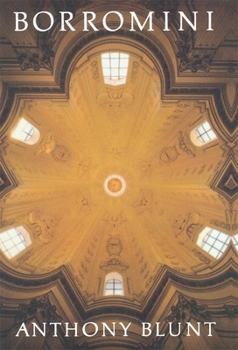
Borromini

Select Format
Select Condition 
Book Overview
Revised
Format:Paperback
Language:English
ISBN:0674079264
ISBN13:9780674079267
Release Date:September 1979
Publisher:Harvard University Press
Length:240 Pages
Weight:0.82 lbs.
Dimensions:0.7" x 6.0" x 9.1"
Customer Reviews
2 ratings
An Enlightening Introduction to Borromini's Rome
Published by Thriftbooks.com User , 17 years ago
When I was living in Rome, I became aware of Borromini in a general way, through such delights as the "long" Colonnade at the Palazzo Spada, and the corkscrew exterior of the lantern tower of Sant' Ivo, but as many times as I gazed out of my bedroom window at the cupola of Sant' Andrea della Valle, I never noticed the "pairs of Ionic columns [that] share a common capital" [24], or the "cherub's heads" that are a variation on the "eggs of the egg-and-tongue motif" on the cornice of Sant' Ivo [19]. In other words, I had no idea what to look for. In this engaging book, Anthony Blunt not only brings such fascinating details to light, but he also explains the complex theory of what he observes to be Borromini's revolutionary take on ancient architecture in terms that are comprehensible to the reader who is not an expert in art history. The only drawback to the book, which, one would think that Harvard University Press would remedy since the book is in its fifth printing, is the quality of the black-and-white photographs, which are liberally dispersed throughout the book. Although not an issue as far as the illustration of architectural plans is concerned, some of the photographs are of poor quality [An example is that of Borromini's Colonnade at Palazzo Spada, which is so dingy that it obscures the incredible illusion of the forced perspective entirely. A shame, because with digital photographs, this readable work would make a splendid "coffee-table book."]. Reading this book makes me want to get on the next plane and fly back to Rome [any excuse!], where I shall certainly look at Borromini's architecture with new eyes.
the best book on borromini
Published by Thriftbooks.com User , 26 years ago
This book offers an excellent introduction both to the architecture of Francesco Borromini and the architecture of the Italian Baroque. Particularly useful are the comparisons between antique and renaissance architecture (particularly Michelangelo). An indispebsable book for anyone interested in Baroque or Italian architecture in general.
Copyright © 2026 Thriftbooks.com
Terms of Use | Privacy Policy | Do Not Sell/Share My Personal Information | Cookie Notice | Cookie Preferences | Accessibility Statement
ThriftBooks ® and the ThriftBooks ® logo are registered trademarks of Thrift Books Global, LLC
ThriftBooks ® and the ThriftBooks ® logo are registered trademarks of Thrift Books Global, LLC
