


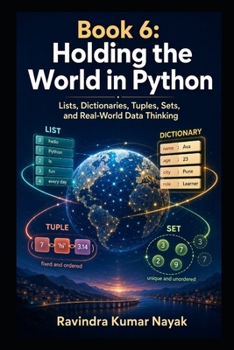
Book 6: Holding the World in Python
No Customer Reviews

What happens after a beginner learns functions?
They begin to ask a deeper question:
How does Python hold many pieces of information at once?
Book 6: Holding the World in Python continues the Python Mindset Ladder with a calm, first-principles journey into Python's most important data structures: lists, dictionaries, tuples, sets, and real-world data thinking.
This book is written for non-technical readers who may understand small pieces of Python but still feel unsure when information becomes larger, messier, or more connected. Instead of rushing into syntax, the book begins with simple human situations: a table full of cards, a shelf of ordered tasks, a labeled student record, a fixed travel ticket, a basket that removes duplicates, and small datasets that answer real questions.
Step by step, the reader learns how Python organizes information:
A list becomes an ordered shelf for tasks, names, scores, expenses, and values that may grow or change.
A dictionary becomes a labeled room where facts can be found by meaningful keys such as name, city, score, email, or role.
A tuple becomes a stable bundle for information that belongs together and should travel as one unit.
A set becomes a clean uniqueness basket that helps remove repeats, check membership, and compare groups.
Then the book connects these ideas into real data thinking: choosing the right container, searching safely, updating carefully, reading nested data one layer at a time, and building small beginner-friendly projects such as an expense tracker, contact book, inventory shelf, habit garden, reading tracker, and mini report builder.
The writing style is gentle, visual, and dialogue-rich. Each chapter builds knowledge in layers, using first-principles explanations, calm examples, reflective checkpoints, practical exercises, mind maps, and short poetic pauses that make the learning experience feel human rather than mechanical.
This book does not assume a technical background. It does not ask the reader to memorize everything at once. Instead, it teaches the reader to ask better questions:
Does order matter?
Do labels matter?
Should the information stay fixed?
Should duplicates disappear?
What does the program need to find, update, or protect?
How can a large problem become smaller chunks?
By the end, the reader will not only recognize Python data structures - they will understand why they exist, when to use them, and how they turn loose information into useful programs.
Book 6: Holding the World in Python is for readers who want Python to stop feeling like scattered commands and start feeling like a clear way to organize the world.
They begin to ask a deeper question:
How does Python hold many pieces of information at once?
Book 6: Holding the World in Python continues the Python Mindset Ladder with a calm, first-principles journey into Python's most important data structures: lists, dictionaries, tuples, sets, and real-world data thinking.
This book is written for non-technical readers who may understand small pieces of Python but still feel unsure when information becomes larger, messier, or more connected. Instead of rushing into syntax, the book begins with simple human situations: a table full of cards, a shelf of ordered tasks, a labeled student record, a fixed travel ticket, a basket that removes duplicates, and small datasets that answer real questions.
Step by step, the reader learns how Python organizes information:
A list becomes an ordered shelf for tasks, names, scores, expenses, and values that may grow or change.
A dictionary becomes a labeled room where facts can be found by meaningful keys such as name, city, score, email, or role.
A tuple becomes a stable bundle for information that belongs together and should travel as one unit.
A set becomes a clean uniqueness basket that helps remove repeats, check membership, and compare groups.
Then the book connects these ideas into real data thinking: choosing the right container, searching safely, updating carefully, reading nested data one layer at a time, and building small beginner-friendly projects such as an expense tracker, contact book, inventory shelf, habit garden, reading tracker, and mini report builder.
The writing style is gentle, visual, and dialogue-rich. Each chapter builds knowledge in layers, using first-principles explanations, calm examples, reflective checkpoints, practical exercises, mind maps, and short poetic pauses that make the learning experience feel human rather than mechanical.
This book does not assume a technical background. It does not ask the reader to memorize everything at once. Instead, it teaches the reader to ask better questions:
Does order matter?
Do labels matter?
Should the information stay fixed?
Should duplicates disappear?
What does the program need to find, update, or protect?
How can a large problem become smaller chunks?
By the end, the reader will not only recognize Python data structures - they will understand why they exist, when to use them, and how they turn loose information into useful programs.
Book 6: Holding the World in Python is for readers who want Python to stop feeling like scattered commands and start feeling like a clear way to organize the world.
Format:Paperback
Language:English
ISBN:B0H6TKMH8B
ISBN13:9798184642765
Release Date:June 2026
Publisher:Independently Published
Length:416 Pages
Weight:1.10 lbs.
Dimensions:1.0" x 6.0" x 9.0"
Customer Reviews
0 rating
Copyright © 2026 Thriftbooks.com
Terms of Use | Privacy Policy | Do Not Sell/Share My Personal Information | Cookie Policy | Cookie Preferences | Accessibility Statement
ThriftBooks ® and the ThriftBooks ® logo are registered trademarks of Thrift Books Global, LLC
ThriftBooks ® and the ThriftBooks ® logo are registered trademarks of Thrift Books Global, LLC
