


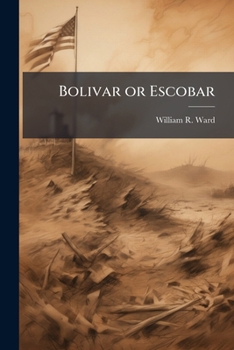
Bolivar or Escobar: The Nature of Colombian Guerrillas

Though the US is physically located in the Western Hemisphere, for most of its history, policy toward the South American countries that share this region has taken a distant second to Euro-centric issues. One of the few areas of concern that has consistently energized contemporary debate about relations with these Southern neighbors is the "war on drugs." In Colombia, the narcotics trafficking problem has become increasingly complex as drug trade has merged with a fifty-year-old insurgency that appears to be gaining strength. Colombia's position in the national discourse has been raised recently with the request by the government of Colombia for $1.3 billion in financial and materiel aid to support its Plan Colombia, a $7.5 billion counter-narcotic, counter-insurgency offensive. Recent US policy toward Colombia has been dominated by concerns about narco-trafficking. Although the government of Colombia is dealing with an extremely complex security threat, the US government has chosen to restrict its assistance to only those activities that are both directly contributing to the counter-narcotic effort and distinct from any counter-insurgent efforts. There are oft-stated fears of becoming mired in a Vietnam-style conflict. Unfortunately, the difficulty of distinguishing between counter-narcotic and counter-insurgent operations cannot be overestimated in the present Colombian environment. Many pundits and even some government officials attempt to simplify the equation by claiming the dominant insurgent group-Revolutionary Armed Forces of Colombia (Fuerzas Armadas Revolucionarias de Colombia--FARC) is no longer a group of revolutionaries driven by ideology and a desire to supplant the existing government, but have instead devolved into a criminal drug organization with an insurgent propagandistic fa ade. If this conclusion were accurate, it could potentially simplify implementation of US policy and reduce the strings attached to aid for the Colombian government. If, how
This work has been selected by scholars as being culturally important, and is part of the knowledge base of civilization as we know it. This work was reproduced from the original artifact, and remains as true to the original work as possible. Therefore, you will see the original copyright references, library stamps (as most of these works have been housed in our most important libraries around the world), and other notations in the work.
This work is in the public domain in the United States of America, and possibly other nations. Within the United States, you may freely copy and distribute this work, as no entity (individual or corporate) has a copyright on the body of the work.
As a reproduction of a historical artifact, this work may contain missing or blurred pages, poor pictures, errant marks, etc. Scholars believe, and we concur, that this work is important enough to be preserved, reproduced, and made generally available to the public. We appreciate your support of the preservation process, and thank you for being an important part of keeping this knowledge alive and relevant.
Related Subjects
Education Education & Reference History Political Science Politics & Social SciencesCustomer Reviews
ThriftBooks ® and the ThriftBooks ® logo are registered trademarks of Thrift Books Global, LLC
