


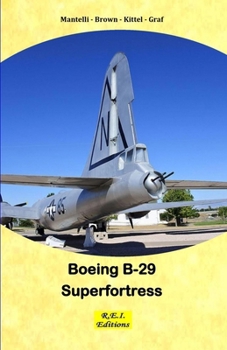
Boeing B-29 Superfortress
No Customer Reviews

New edition completely revised and updated. The Boeing B 29 Superfortress will be remembered as the aircraft to have used the atomic weapon in action during the war: it was, in fact, aircraft of this type that dropped the atomic bombs on Hiroshima and Nagasaki to force Japan to surrender in August 1945.
The Superfortress was designed for high-altitude strategic bombing, but also excelled in low-altitude nighttime incendiary bombing and the dropping of naval mines to blockade Japan.
One of the largest aircraft of World War II, the B-29 was designed with cutting-edge technology, which included a pressurized cabin, a two-wheel tricycle landing gear, and a computer-controlled analog fire control system, which allowed a gunner and a fire control officer to direct four remote machine gun turrets.
The design and production cost of $3 billion, equivalent to $51 billion in 2024 dollars, far exceeding the $1.9 billion cost of the Manhattan Project, made the B-29 program the most expensive of the war.
The B-29 was capable of flying at altitudes of up to 9,710 metres (31,850 ft) at speeds of up to 560 km/h (350 mph): this was its best defense, because Japanese fighters could barely reach that altitude and few could catch the B-29 even if they did.
The most famous B-29s were the Silverplate series, which were extensively modified to carry nuclear weapons.
- Initially, it was considered to use the British Lancaster as a nuclear bomber, as this would require fewer modifications. However, the B-29's superior range and high-altitude performance made it a much better choice, and after the B-29 began to be modified in November 1943 to carry the atomic bomb, the suggestion of using the Lancaster was never considered again.
The Superfortress was designed for high-altitude strategic bombing, but also excelled in low-altitude nighttime incendiary bombing and the dropping of naval mines to blockade Japan.
One of the largest aircraft of World War II, the B-29 was designed with cutting-edge technology, which included a pressurized cabin, a two-wheel tricycle landing gear, and a computer-controlled analog fire control system, which allowed a gunner and a fire control officer to direct four remote machine gun turrets.
The design and production cost of $3 billion, equivalent to $51 billion in 2024 dollars, far exceeding the $1.9 billion cost of the Manhattan Project, made the B-29 program the most expensive of the war.
The B-29 was capable of flying at altitudes of up to 9,710 metres (31,850 ft) at speeds of up to 560 km/h (350 mph): this was its best defense, because Japanese fighters could barely reach that altitude and few could catch the B-29 even if they did.
The most famous B-29s were the Silverplate series, which were extensively modified to carry nuclear weapons.
- Initially, it was considered to use the British Lancaster as a nuclear bomber, as this would require fewer modifications. However, the B-29's superior range and high-altitude performance made it a much better choice, and after the B-29 began to be modified in November 1943 to carry the atomic bomb, the suggestion of using the Lancaster was never considered again.
Format:Paperback
Language:English
ISBN:2372973576
ISBN13:9782372973571
Release Date:February 2019
Publisher:Edizioni R.E.I. France
Length:174 Pages
Weight:0.46 lbs.
Dimensions:0.4" x 5.5" x 8.5"
Related Subjects
HistoryCustomer Reviews
0 rating
Copyright © 2026 Thriftbooks.com Terms of Use
| Privacy Policy | Do Not
Sell/Share My Personal Information | Cookie Policy | Cookie Preferences | Accessibility Statement
ThriftBooks® and the ThriftBooks® logo are registered trademarks of Thrift Books Global, LLC
ThriftBooks® and the ThriftBooks® logo are registered trademarks of Thrift Books Global, LLC
