


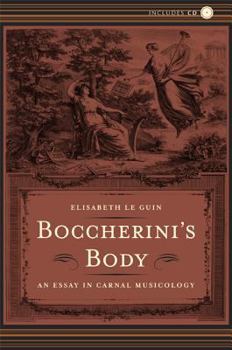
Boccherini's Body: An Essay in Carnal Musicology

In this elegant study of the works of the undeservedly neglected composer Luigi Boccherini, Elisabeth Le Guin uses knowledge gleaned from her own playing of the cello as the keystone of her original approach to the relationship between music and embodiment. In analyzing the striking qualities of Boccherini's music--its virtuosity, repetitiveness, obsessively nuanced dynamics, delicate sonorities, and rich palette of melancholy affects--Le Guin develops a historicized critical method based on the embodied experience of the performer. In the process, she redefines the temperament of the musical Enlightenment as one characterized by urgent, volatile inquiries into the nature of the self.
Format:Hardcover
Language:English
ISBN:0520240170
ISBN13:9780520240179
Release Date:November 2005
Publisher:University of California Press
Length:376 Pages
Weight:1.65 lbs.
Dimensions:1.2" x 6.4" x 9.3"
Customer Reviews
1 rating
Who Let the Cat [Gut] Out of the Bag?
Published by Thriftbooks.com User , 15 years ago
Elizabeth LeGuin is the third in a dynasty of brilliant women writers. Her mother is the popular science fiction novelist Ursula LeGuin, and her grandmother was Theodora Kroeber, author of "Ishi". In this complex study of the music of Luigi Boccherini (1743-1805), LeGuin discloses a "secret" that every skilled musician already knows: Composers write music for performers, not audiences. More cautiously, one might say that composers necessarily write with performers in mind. It's the composer's ability to sense the performer empathically, to imagine her hands as his on the instrument or his voice resonating in her larynx, which enables him to write in a musical idiom that she can also `speak', even if he is long dead. This notion of composer and performer occupying the same physical space is a central thesis of cellist Elizabeth LeGuin's musicological biography of cellist/composer Luigi Boccherini. Here's another way to express it: Performers, even if they perform only for their cat or their begonias, experience music on several levels not accessible to passive listeners. Ergo, performers comprise the composer's most satisfying audience, in that only the performers can "get" the whole experience that the composer conceives. I realize that this might be an invidious distinction, and an offensive one, for non-performers who are passionately moved by music. And can it possibly be true or apt for ALL composers? Perhaps we can ignore that question, since we (i.e. Dr. LeGuin) are concentrating our thoughts on one specific composer, Boccherini, who indisputably wrote the bulk of his music for the pleasure of --and purchase by-- performers. But Boccherini lived and composed in a milieu where a major percentage of "the better classes" were somewhat competent at music; they sang and/or played for recreation, among their own families and friends. I could get into troubled waters here by speculating that the paucity of active performers, professional or amateur, in the later 20th C, and the nexus of all cash with passive concert-hall listeners, have fatally disrupted the social bonds of composer and performer. Be that as it may, author LeGuin calls attention to some of the ways that only a performer necessarily experiences music like Boccherini's. First, there is a visual experience. The performer looks at the score, reads the notes. The `Early Music' movement of our era has made a considerable point about the value of seeing the music as the composer saw it, in original notation. When the music is 15th C polyphony, with its neumes and colorations and total absence of barlines, the point seems indisputable. But even music of the later 18th C, the era of Haydn and Mozart as well as Boccherini, often `looked' quite different from modern editions. In a modern edition, nearly all the music is notated in the treble G clef, the G clef indicated as sounding an octave lower, or the bass F clef. A cellist in Pomerania who purchased a print of a Boccherini sonata pub
Copyright © 2026 Thriftbooks.com Terms of Use
| Privacy Policy | Do Not
Sell/Share My Personal Information | Cookie Policy | Cookie Preferences | Accessibility Statement
ThriftBooks® and the ThriftBooks® logo are registered trademarks of Thrift Books Global, LLC
ThriftBooks® and the ThriftBooks® logo are registered trademarks of Thrift Books Global, LLC
