


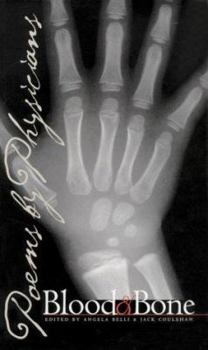
Blood & Bone: Poems by Physicians

Select Format
Select Condition 
Book Overview
An anthology of 100 poems, written by physicians, exploring the connections between medicine and poetry.
Format:Hardcover
Language:English
ISBN:0877456372
ISBN13:9780877456377
Release Date:January 1998
Publisher:University of Iowa Press
Length:160 Pages
Weight:0.94 lbs.
Dimensions:0.7" x 6.0" x 9.6"
Customer Reviews
2 ratings
Poet/physician
Published by Thriftbooks.com User , 20 years ago
Auden said a poet's job is to notice things. This is also a physician's job, when he or she is trying to diagnose. As a physician and an appreciator of poetry, I think this book succeeds admirably. The poems are breath-taking in their beauty and power, and demonstrate the humanity of both peopole in the patient physician encounter. It makes a perfect gift for that special physician in your life
This is a book of poetry that should be read and reread.
Published by Thriftbooks.com User , 27 years ago
The editors of Blood and Bone have assembled a fine and varied collection of poetry by physicians. When I first opened this book, I wondered what I would find--what do our doctors think about as they attempt to cure us, attempt to fight off our diseases and our deaths? I wanted to find love, compassion, and, most of all, evidence of humanity, and I did. In section one, the physicians consider their patients, often speaking in the patient's voice, and they present the tools of their trade. Here's the first stanza of Dannie Abse's lovely and haunting "The Stethoscope," an example of the quality and depth of the poetry throughout this volume: Through it,/ over young women's abdomens tense,/ I have heard the sound of creation / and, in a dead man's chest, the silence / before creation began.Also in this section, see "The Azalea Poem" by Jack Coulehan. In this poem the doctor admits that the false hope he gave a patient was "colored by my need." At home, the physician grieves for time lost, for the imperfection of life and relationship, for the elusive, everyday pleasures in a poem that's touching, painfully honest, and reassuringly humane. Alice Jones' "Tap" relates the poet's sensual vision of a successful spinal tap, admitting not love for the patient, but sheer delight in the procedures and successes of the trade. In the second section, we hear what the physician thinks about when away from the hospital or office, and we're surprised, perhaps, to learn that doctors worry, fret, and ponder the significance and the horror of what they must do in the name of healing. Rafael Campo daydreams while taking a bath, washing away "The hospital, the incurable illnesses," in his "El Curandero," and Kristen Emmott vents her frustration at being wife, mother, and physician, juggling family and housework in a poem that's both funny and poignant, "Who Looks After Your Kids?" This section, because it intertwines the personal with the professional, is extremely moving and contains some of the finest poems. For example, see John Graham-Pole's "Leaving Mother, 1954." The third section looks at teaching and education, and, as all the sections do, presents many poems about death--the monster that these physicians most often try to defeat both in their work and in their poems. Especially in the poems about autopsy, the reader gets a sense of the physician's fear and awe when looking into the human body--as Campo says, "It was terrible, what the body told." Outstanding poems here include Abse's "Carnal Knowledge" and "The Origin of Music"; Jack Coulehan's "Anatomy Lesson" (one of the most moving and reassuring poems in this collection) and "The Rule of Thirds"; and John Stone's "Gaudeamus Igitur: A Valediction." The final section presents poems that transcend the individual patient and physician and consider the world beyond, where suffering becomes universal and political. For me, these poems were less successfu
Copyright © 2026 Thriftbooks.com Terms of Use
| Privacy Policy | Do Not
Sell/Share My Personal Information | Cookie Policy | Cookie Preferences | Accessibility Statement
ThriftBooks® and the ThriftBooks® logo are registered trademarks of Thrift Books Global, LLC
ThriftBooks® and the ThriftBooks® logo are registered trademarks of Thrift Books Global, LLC
