


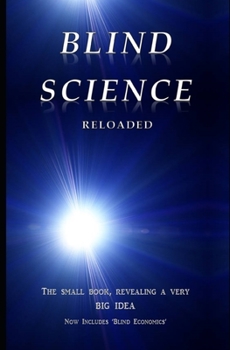
BLIND SCIENCE RELOADED: A SMALL BOOK REVEALING A VERY BIG IDEA
No Customer Reviews

If I were to ask: 'Why do celebrated physicists researching space, time, gravity and the quantum world, describe their own methodically verified results as weird'. What would you reply?...Why would reality be... 'weird'? Surely, scientifically speaking, reality is just, well... reality? Where does 'weirdness' come into this equation? Maybe reality is not the one with the problem here."If you can't explain something in easily understandable everyday terms; you either don't understand it yourself, or you are trying to manipulate someone". I kept that principle in mind the whole way through this work. There is no need for a PhD in quantum mechanics, etymology, ancient history, evolutionary psychology or philosophy to appreciate what's in here. There should be no intellectual snobbery when it comes to this kind of thing. For this work, accessibility is as important as content; aiming for something where, when you read this, if you think it's 'beneath you', you will by the end change your mind; and if you think it's 'beyond you', equally that presumption will prove challenged in the end.To meaningfully understand why scientists describe their own methodically verified results as 'weird'; why, despite all the technology and understanding advantages of the modern age, confusion, conflict and suffering endure or deteriorate, you have to go way back into our shared history; unpick the evidence from the beginning with a respectful open mind. Understand how the ancients thought, how we think and what the differences are; where languages come from, why science in its current form doesn't provide answers for certain things; link them back together again, to finally make sense of it all.Once you understand things don't quite look the same; the world around becomes less intimidating, personal courage enhanced; different decisions made, changed behaviors reinforced when science is fused, without contradicting its own evidence, within a contemporary framework that allows one to 'believe'. Faith in our futures restored, made contemporary sense of with no need to engage in 'magical' thinking, no matter your background, faith or lack thereof. A shift in perception courtesy of ancient wisdom, all that is required to unlock the impasse for atheists, scientists and believers alike.Einstein understood science emerged from and is subordinate to the philosophy from whence it came. Einstein used extensive philosophical study and understanding to explore a revision to the rules of science, in so doing he revolutionized science itself. A similar approach is needed to unlock the impasse of our times. I suspect Einstein already knew the answer back then, but it was not the right time when he was around to clearly express what he thought, opting to leave plenty of clues behind for us to find instead.Not saying I have all the answers in here. Your path to understanding will be different from mine. This work offers a carefully engineered map for guidance towards your own path to discovery; posing a series of unexpected and intriguing questions to challenge what you may 'think' you believe along the way; a cause for pause, thought and reflection, and in the end offering an answer for consideration. The price of entry? Keep a respectful open mind throughout; don't rush, be honest with yourself. Don't understand? Do some research of your own to challenge the ideas, take a break, re-read.If Einstein knew, he was right not to tell anyone at that time. Times have changed. Now if we don't tell everyone, we may arrive at the place he wished us to avoid; the path may be different, but the final destination... it will be the same. Simon Blackwater - May 2020 - Sydney, Australi
Format:Paperback
Language:English
ISBN:1692031538
ISBN13:9781692031534
Release Date:September 2019
Publisher:Independently published
Length:78 Pages
Weight:0.50 lbs.
Dimensions:8.0" x 0.2" x 5.3"
Customer Reviews
0 rating
Copyright © 2026 Thriftbooks.com Terms of Use
| Privacy Policy | Do Not
Sell/Share My Personal Information | Cookie Policy | Cookie Preferences | Accessibility Statement
ThriftBooks® and the ThriftBooks® logo are registered trademarks of Thrift Books Global, LLC
ThriftBooks® and the ThriftBooks® logo are registered trademarks of Thrift Books Global, LLC
