


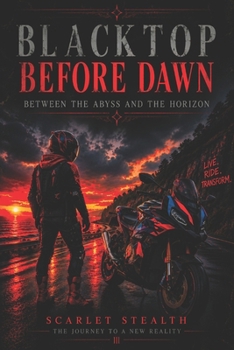
BlackTop Before Dawn: Between the Abyss and the Horizon

Blacktop Before Dawn is a deeply personal poetry collection about the journey from surviving to becoming. Written through the eyes of a solitary biker moving through midnight roads, rain-soaked highways, unfamiliar places, and quiet horizons, the book uses the motorcycle and the blacktop as metaphors for life itself. The road represents everything that has been endured, the heartbreak, loneliness, love, disappointment, self-doubt, scars, and trials that shape a person, while the approaching dawn represents the possibility of becoming someone new. At its heart, the book is about a woman learning to stop running from herself. She has spent years pouring into other people, loving deeply, carrying emotional weight that wasn't always hers, and sometimes giving until her own cup was empty. She has known what it means to miss people, to wonder if someone will return, to love women who could not always meet her where she stood, and to discover that caring for someone should never require abandoning yourself. But Blacktop Before Dawn doesn't remain in heartbreak. The journey gradually changes. The biker begins to understand that her scars are not evidence of weakness. They are evidence that she kept riding. The helmet becomes both armor and sanctuary. The motorcycle becomes freedom. The engine becomes a heartbeat. The road becomes transformation. The night becomes everything she had to survive. And the dawn becomes the future she finally chooses. Throughout the collection, she rides into unfamiliar places, not necessarily because she is lost, but because she refuses to believe that the life she was given is the only life she can have. She begins imagining new cities, new roads, new dreams, new art, new love, and a future built deliberately with her own hands. The book also explores what it means to become a better person because of suffering rather than being destroyed from it. She doesn't want her scars to become an excuse to hurt others. She doesn't want to bleed people dry simply because she once knew what it was like to thirst. She wants to create something good from everything she has endured. She wants to leave people with hope. She wants someone else traveling through their own darkness to see her headlights in the distance and think:
"Maybe I can keep going too."
That is where the book's transformation becomes most important. She stops asking "Who will save me?"
And begins asking "What can I build? Who can I become? What can I leave behind?..." Until finally she says "Enough has enough."
The collection moves from longing to self-respect, from grief to freedom, from darkness to creation, and ultimately from survival to hope. And the dawn isn't portrayed as some magical moment where everything becomes perfect. The scars remain. The memories remain. The people she loved remain part of her story. But she no longer needs to live inside those chapters. By the final poems, she has stopped riding away from the darkness. She is riding toward something. A new reality. A life that belongs to her. A horizon she hasn't seen yet. And when dawn finally arrives, she doesn't need it to rescue her. She realizes she has already done the hardest part.... She kept riding.
Customer Reviews
ThriftBooks ® and the ThriftBooks ® logo are registered trademarks of Thrift Books Global, LLC
