


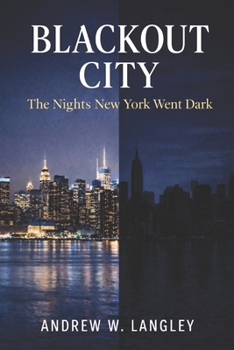
Blackout City: The Nights New York Went Dark

On three separate nights, the lights went out.
In 1965, a relay failure near Niagara Falls plunged New York City into darkness and revealed how deeply modern life depended on invisible systems. In 1977, lightning and heat triggered a blackout that exposed not only technical fragility but social fracture. In 2003, a software failure hundreds of miles away silenced a digital metropolis at the height of the workday.
Each event lasted only hours.
Each reshaped the city for years.
In Blackout City, Andrew W. Langley traces the electrification of New York from the age of gaslight to the era of interconnected continental grids, then follows the cascading failures that darkened one of the world's most illuminated skylines. Drawing on federal investigations, newspaper accounts, eyewitness testimony, and cultural memory, he examines what blackouts reveal about infrastructure, inequality, public trust, and the fragile agreements that hold modern cities together.
This is not a disaster chronicle. It is a history of systems under strain, of neighborhoods responding differently to the same darkness, and of how memory reshapes crisis long after power returns.
When the skyline flickers back to life, what remains is not simply relief. It is a question:
How stable is the light we take for granted?
Customer Reviews
ThriftBooks ® and the ThriftBooks ® logo are registered trademarks of Thrift Books Global, LLC
