
Skip to content
Scan a barcode
Scan
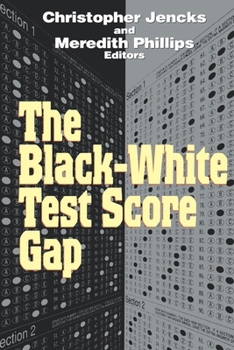
Paperback The Black-White Test Score Gap Book

ISBN: 0815746091

ISBN13: 9780815746096

The Black-White Test Score Gap

Select Format

Select Condition ThriftBooks Help Icon

Recommended

Format: Paperback

Condition: Good

$9.69
Save $18.30!
List Price $27.99
Almost Gone, Only 1 Left!
Save to List

Book Overview

The test score gap between blacks and whites-on vocabulary, reading, and math tests, as well as on tests that claim to measure scholastic aptitude and intelligence--is large enough to have far-reaching social and economic consequences. In their introduction to this book, Christopher Jencks and Meredith Phillips argue that eliminating the disparity would dramatically reduce economic and educational inequality between blacks and whites. Indeed, they think that closing the gap would do more to promote racial equality than any other strategy now under serious discussion. The book offers a comprehensive look at the factors that contribute to the test score gap and discusses options for substantially reducing it.
Although significant attempts have been made over the past three decades to shrink the test score gap, including increased funding for predominantly black schools, desegregation of southern schools, and programs to alleviate poverty, the median black American still scores below 75 percent of American whites on most standardized tests. The book brings together recent evidence on some of the most controversial and puzzling aspects of the test score debate, including the role of test bias, heredity, and family background. It also looks at how and why the gap has changed over the past generation, reviews the educational, psychological, and cultural explanations for the gap, and analyzes its educational and economic consequences.

The authors demonstrate that traditional explanations account for only a small part of the black-white test score gap. They argue that this is partly because traditional explanations have put too much emphasis on racial disparities in economic resources, both in homes and in schools, and on demographic factors like family structure. They say that successful theories will put more emphasis on psychological and cultural factors, such as the way black and white parents teach their children to deal with things they do not know or understand, and the way black and white children respond to the same classroom experiences. Finally, they call for large-scale experiments to determine the effects of schools' racial mix, class size, ability grouping, and other policies.
In addition to the editors, the contributors include Claude Steele, Ronald Ferguson, William G. Bowen, Philip Cook, and William Julius Wilson.

Customer Reviews

3 ratings

An Almost Solid Meta-Analysis of a Persistent but Not-So Perplexing Educational Problem

The editors of this collection of carefully worded journal articles have brought the public (and often less informed) debate about racial disparity in test score results back to the academic arena at a critical juncture. As another reviewer noted, the quantitative analysis can and does indeed distract from the thrust of the arguments being put forward, but not overly so unless one is a lay reader uninitiated in this lingering debate. If you have grown weary of ideologically-charged elements in this debate, you will welcome this collection. The editors have included articles that address with varying degrees of success the many issues and causes which come to the fore when the topic of the test score gap is broached. My only criticism is that more should have been offered by way of a contrasting viewpoint about how the current phenomenon of the decline (and in many instances) disintegration of the nuclear black family has exacerbated this racial learning gap. Concern for a lack of social and economic capital is legitimate fodder for discussion but one should not ignore the elephant in the parlor--the fact that 7 in 10 black children are now born out of wedlock. Cook and Ludwig's article on the burdens of acting white should be well noted as it gets at the most overlooked source of the problem. Few articles over the past two decades have appeared in either the academic or popular press about this pernicious trend in the black community. Steele and Aronson's social psychological study at Stanford University in the early 1990s that led to their promulgation of a stereotype threat deserves special attention if only because the study has not been replicated on a comparable or larger scale. Yet the existence of such a threat is now taken as a given by many eager to assign blame beyond the home. Yet few who embrace this factor will publicly admit that the very affirmative action policies, for instance, that include "National Black Achiever" categories for PSAT test takers continually remind black high school juniors that they have not and do not need to achieve at the same level to receive some semblance of national academic recognition. Low expectations emanate as much if not more from political decisions beyond the school door as behind it. It is this last point that the reader should most bear in mind as he or she reads these articles. A previous reviewer from Cleveland and a college minority affairs officer would have us believe that most white teachers in the inner-city are biased in their regard for the academic potential of their black students and are themselves relatively incompetent. As one who taught for a decade in the inner-city at a predominantly black SWS (school-within-a-school) high school (and taught some of the participants in the Steele-Aronson study) and had occasion to visit dozens of schools with similar demographics, I must take issue with his point. Indeed, as this volume neglects to address, perhaps inadvertently, many of t

Overwhelming evidence

This book brings together numerous research studies for various reasons behind the Black-White test score gap. It compares and contrasts studies, reveals skewed statistics and backs up grounded ones. I would recommend this to teachers and other professionals associated with the learning of children and giving of standardized tests. I can't say that after reading this I have any major findings, but it did open my eyes to some of my own biases and confirmed teaching methods and classroom community building ideas I have. I found the statistics in this book a bit overwhelming, but the related underlying ideas were well-explained. I would suggest that a top-notch mathematician would be very interested in how research was tabulated. Other than that, I find this a worthwhile insight to the facts associated with the B-W test score gap. It raised many questions as to the validity of some research, and showed me that many answers are not just "black and white" in response to the situation.

Honest and Reflective Essays on the Test Score Gap

I work in the minority affairs at a major univerity. One of the questions I often get from majority and minority students and faculty is, "why are the scores--on average--so much lower for minority students than other students". Sometimes the implied message is, are the Black students dumber? The Black-White Test Scoe Gap is the best source I know for answering this and questions without getting defensive. The book makes plain that their is not just one "answer", but many theories. I have always thought a big chunk of the problem had to do with so many lower middle class white teachers who had low expectations for Black children. Interestingly, one of the writers agrees that the gap has something to do with the teachers, but notes a different problem: teachers (regardless of race)in urban areas tend to have low standardized test scores themselves and therefore may find it difficult to improved the scores of their students. I highly recommend this book.
Copyright © 2026 Thriftbooks.com Terms of Use | Privacy Policy | Do Not Sell/Share My Personal Information | Cookie Policy | Cookie Preferences | Accessibility Statement
ThriftBooks® and the ThriftBooks® logo are registered trademarks of Thrift Books Global, LLC

GoDaddy Verified and Secured