


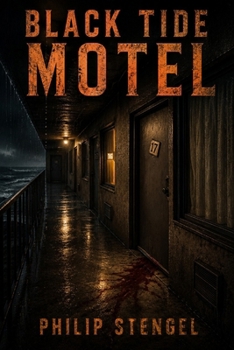
Black Tide Motel

In the autumn of 1987, five men checked into the Black Tide Motel and were never seen alive again.
The county closed the case in a week. A drifter named Thomas Keene took the fall. A confession was signed by the men who called it a confession, a folder went into the damp of a county archive, and a coast that lived on visitors got its quiet back before the tourist season could feel the loss. The questions that did not fit the story were left where they were. For thirty-nine years, no one with the power to reopen the folder had any appetite to learn what a second look would cost.
Now a small true-crime documentary crew has come back to the north coast to film a reconstruction of the murders. The motel is exactly where it has always been, crouched low on a rock shelf with the sea hammering the stone below and the neon dead in the rain. It does not look abandoned and it does not look open. It looks occupied, the way a body is occupied right up until the moment it is not.
Mara Vale reads buildings for a living. This one is lying to her.
The rooms have been renumbered. The walls have been moved. Trim that does not meet the corners, plaster patched over older plaster, a room that should exist and is missing from every count. Mara has scouted a hundred dead places and learned that a structure tells the truth about the people who made it whether they meant it to or not. Black Tide is telling her something she does not want to hear. And the deeper the crew goes into the off-season dark, the less the old case reads like history and the more it reads like a set of instructions.
Then the sounds start behind the walls. Then the storm closes the roads. Then the crew stops being a crew and starts being a count.
Because the Black Tide Motel was never only a place to sleep. It had a front desk and a filing system and a route down to the sea. It had a way of marking which guest came in alone, which came in mean, which would not be asked after quickly. It had a way of deciding who would be missed by Monday and who would not. The killings were not one night of violence to be reconstructed. They were a working arrangement, with a paper trail and a cleanup plan, and someone who knows exactly how that arrangement ran is still moving through the building.
What the crew uncovers is not a ghost story. It is worse, because all of it is made of ordinary things. Fishing line and treble hooks. Words left in grease pencil for the living to find. Rooms hidden behind the rooms that were sold. A drainage cut under the west wing where the tide comes up higher than it should and takes what it is given.
Cut off by the flood, the crew begins to come apart. The host wants an episode. The sheriff has his own reasons to keep the old case shut. The owner knows more than she will say, and every hour the sea rises another inch against the rock. One by one they learn the only rule the motel has ever run on. The people who start things in this building do not get to decide whether they finish them.
Mara took this job for a reason she has told no one on the crew. Her mother vanished from this coast the year the killing began, and the answer is folded into a postcard in her pocket and into the walls of a building that has been waiting a long time for someone to come back and read the seam. What she finds under the motel is not the mother she spent her life inventing. It is truer than that. And it is not finished with her.
The record was written clean. The wrong man went to prison. The building is still standing.
BLACK TIDE MOTEL is a slow-burn coastal folk horror for readers who like their dread built out of ordinary things, their monsters made of memory and labor, and their true crime told from inside the walls where the official story never bothered to look.
The sea takes what it wants and gives back only what it cannot use.
Customer Reviews
ThriftBooks ® and the ThriftBooks ® logo are registered trademarks of Thrift Books Global, LLC
