


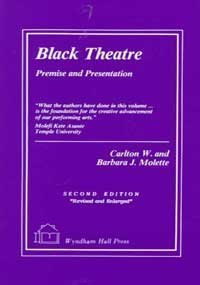
Black Theatre: Premise and Presentation

Select Format
Select Condition 
Book Overview
Our intention, explain the Mollettes, is to describe the nature of African American theatre as an expression of culture and a medium for communicating values. We have divided this book into two sections. Part One, PREMISE, describes the terms and concepts needed to examine African American theatre from an Afrocentric point of view. Essential to that discourse is an understanding of culture and values and their impact upon an individual's point of view and subsequent interpretation of what is seen and heard. We cite examples of historical interpretations and analyses to illustrate the differences in these statements of evaluation that result from variations in culture and values. Part Two, Presentation, delineates values that influence theatrical presentations by and for African Americans and their impact upon style, form, and the performance environment. The values of specific cultures also control concepts such as space and time that are crucial to the way in which performance art is perceived. Both Afrocentric and Eurocentric concepts of time and space are described in order to contrast Afrocentric and Eurocentric conventions of theatrical presentations.
Format:Paperback
Language:English
ISBN:093226994X
ISBN13:9780932269942
Release Date:January 1992
Publisher:Wyndham Hall Pr
Length:166 Pages
Weight:0.75 lbs.
Dimensions:8.5" x 0.5" x 5.5"
Customer Reviews
1 rating
response to Willington, CT review
Published by Thriftbooks.com User , 22 years ago
All of us belong to the same race, the human race. Afrocentricism, and other "location-based" descriptions of cultural identity describe a "place" from which one perceives reality. These are not maps of one's genetic origins but orientations to data. This "review" creates fallacious arguments of several well-known types. A red herring focuses attention on irrelevant issues. A straw man misrepresents, oversimplifies, or caricatures to create an idea that is far more vulnerable to attack than the actual idea. Ad hominem arguments attack personal characteristics, real or fabricated, while appearing to attack the idea, often by "name calling" with such words as "sophomoric, covert, and mulatto," or by saying our ideas are "subjective and opinionated generalizations" while those of the reviewer are what? ... objective? ... universal?". . . Carlton Molette is of mostly European descent himself (he is a mulatto), so in criticizing white people, whom he equates with Europeans and eurocentric people, he is really criticizing himself." This ad hominem argument illustrates the degree to which racism permeates this society. The basis of racism is to presume that such characteristics as intelligence and morality are genetically transferred, enabling "the content of one's character" to be observed through such easily recognizable traits of outward appearance as skin color and hair texture. What, other than this most basic of racist assumptions, would kindle this writer's concern about what percentage of my ancestry is European? To describe anyone as "a mulatto" requires acceptance of the idea that some people are "racially pure" while others are not.". . . the authors ramble on . . . regarding material which is largely preferatory in nature." This is a "straw man." We call the first part of the book "PREMISE." We even used the word PREMISE in the book's title and quoted a dictionary definition of the word to explain the purpose of this section of the book. "For instance the authors spend the first 38 pages essentially saying that you cannot understand black theater unless you understand black culture. We know and say in the book that understanding "black culture" has to do with one's culture and one's values. To assume that one's "race" determines one's culture and values makes a racist assumption with which we disagree. "The authors indirectly suggest that the only way to REALLY understand black culture is to be black. . ." This is another "straw man." We do not "indirectly suggest" any such thing. Our discussion of how and when values are acquired come from a very WHITE social scientist, Morris Massey, whose video WHAT YOU ARE IS WHERE YOU WERE WHEN is footnoted in the book. "...the authors divide people into basically three groups: afrocentric, asiocentric, or eurocentric." WE DO NOT DIVIDE PEOPLE! We describe "points of view" or "places from which individuals perceive reality." The book cites Mavor Moore, the WHITE Chairman of the Ca
Copyright © 2026 Thriftbooks.com Terms of Use
| Privacy Policy | Do Not
Sell/Share My Personal Information | Cookie Policy | Cookie Preferences | Accessibility Statement
ThriftBooks® and the ThriftBooks® logo are registered trademarks of Thrift Books Global, LLC
ThriftBooks® and the ThriftBooks® logo are registered trademarks of Thrift Books Global, LLC
