


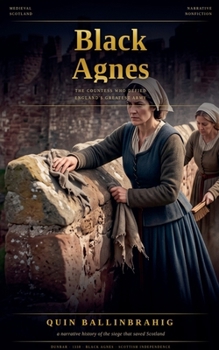
Black Agnes: The Countess Who Defied England's Greatest Army

In January 1338, William Montagu, Earl of Salisbury - one of Edward III's most celebrated commanders - arrived before Dunbar Castle on the Lothian coast with the finest siege army in Britain. What followed was one hundred and fifty-five days of sustained humiliation. The castle did not fall. The garrison held. And the woman who commanded it sent Salisbury a fresh loaf of bread and a flagon of wine to demonstrate that she had provisions to spare.
Agnes Randolph, Countess of Dunbar and March, was not an accidental heroine. She was the eldest daughter of Thomas Randolph, 1st Earl of Moray, regent of Scotland and right hand of Robert the Bruce. She held Dunbar Castle by legal right, exercising the recognised authority of the domina - the lady of the fortress whose command in her husband's absence was prescribed by medieval law, not improvised in a crisis. Her defence was not a series of theatrical gestures but a coherent strategic programme, deliberately planned and precisely executed, targeting Salisbury's reputation as ruthlessly as his artillery targeted her walls.
Black Agnes draws on the latest historical scholarship, including the landmark 2026 research that dismantled two centuries of myth about the origins of her famous epithet, to restore Agnes Randolph to her true historical dimensions: one of the most formidable military commanders of the medieval world.
Customer Reviews
ThriftBooks ® and the ThriftBooks ® logo are registered trademarks of Thrift Books Global, LLC
