


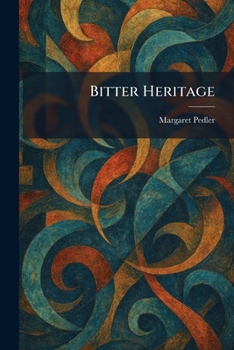
Bitter Heritage

Select Format
Select Condition 
Book Overview
"Bitter Heritage" is a compelling drama of love, honor, and the long shadows cast by the past. Written by the popular novelist Margaret Pedler, this story explores the life of a protagonist burdened by a father's disgraceful legacy. This "bitter heritage" of shame and social ruin threatens to destroy any chance of personal happiness and complicates the path to true love in the rigid social landscape of early 20th-century England.
As secrets are unearthed and hearts are tested, the narrative delves into the conflict between family loyalty and individual redemption. Pedler masterfully weaves a tale of suspense and sentiment, questioning whether a name tainted by scandal can ever be cleared or if the sins of the father must inevitably be visited upon the children. With its blend of heartfelt romance and domestic tension, the novel is a classic example of the romantic melodrama that made Pedler a household name. It remains a poignant exploration of character, the weight of reputation, and the enduring power of affection to overcome the most difficult of circumstances.
This work has been selected by scholars as being culturally important, and is part of the knowledge base of civilization as we know it. This work was reproduced from the original artifact, and remains as true to the original work as possible. Therefore, you may see the original copyright references, library stamps (as most of these works have been housed in our most important libraries around the world), and other notations in the work.
This work is in the public domain in the United States of America, and possibly other nations. Within the United States, you may freely copy and distribute this work, as no entity (individual or corporate) has a copyright on the body of the work.
As a reproduction of a historical artifact, this work may contain missing or blurred pages, poor pictures, errant marks, etc. Scholars believe, and we concur, that this work is important enough to be preserved, reproduced, and made generally available to the public. We appreciate your support of the preservation process, and thank you for being an important part of keeping this knowledge alive and relevant.
Customer Reviews
ThriftBooks ® and the ThriftBooks ® logo are registered trademarks of Thrift Books Global, LLC
