
Skip to content
Scan a barcode
Scan
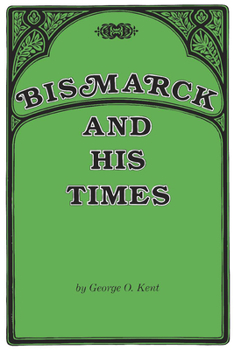
Paperback Bismarck and His Times Book

ISBN: 0809308592

ISBN13: 9780809308590

Bismarck and His Times

Select Format

Select Condition ThriftBooks Help Icon

Recommended

Format: Paperback

Condition: Good

$7.39
Save $19.11!
List Price $26.50
Almost Gone, Only 2 Left!
Save to List

Book Overview

A new account of the life and policies of the first German chancellor, Otto von Bismarck, this concise historical-biography reflects, for the first time in English, the historical shift in emphasis from the traditional political-economic approach to the more complex social-economic one of post--World War II scholarship.

Since the middle of the 1950s, much new material on Bismarck and nine­teenth-century Germany and new inter­pretations of existing material have been published in Germany, Great Britain, and the United States. Pro­fessor George O. Kent's brilliant syn­thesis, drawing on this mass of mate­rial, examines changes in emphasis in post--World War II scholarship. The book, particularly in the historiograph­ical notes and bibliographical essay, provides the serious student with an invaluable guide to the intricacies of recent Bismarckian scholarship. For the general reader, the main text presents a picture of the man, the issues, and the age in the light of modern scholarship.

The major shift in historical emphasis described in this new account is the importance scholars give to the period 1877-79, the years of change from free trade to protectionism, rather than to 1870-71 the founding of the Reich. Bismarck's political machinations, par­ticularly his willingness to explore the possibilities of a coup d'?tat, are more fully discussed here than in any other book.

Customer Reviews

1 rating

Rust On The "Iron Chancellor"'s Facade

George O. Kent's book Bismarck And His Times details the path taken by Prussia that gradually led that nation to unification with other German states under Prime Minister and later Chancellor Otto von Bismarck. That path, however, did not lead the unified Germany towards political maturity, and led to its defeat in two world wars, notoriety for perpetuating the most shocking atrocities publicized in the world, and its division into two countries until eventual reunification in 1990. As a result, Bismarck's achievements were reanalyzed, with post-World War II assessments revealing considerable rust on the "Iron Chancellor"'s facade. Kent is one of those historians, arguing that Bismarck and his foreign and domestic policies were to blame for this tragedy, and the German nation, as well as the North German Confederation that preceded it, "was conceived too narrowly and maintained too rigidly for too long".Consider the constitution of the North German Confederation created by Bismarck in 1866, a lopsided hybrid of an absolute monarchy and a constitutional state, with the executive and upper house holding most of the power. There was the Prussian king--later the Kaiser of Germany--and the members of the Upper House composed of representatives from the North German states. On the other side was the Reichstag, whose members were elected by male property owners, whose powers were limited to pass or defeat bills introduced by the king or Bismarck; the Reichstag could not introduce bills. In addition, the chancellor could not be brought down by a vote of no-confidence from the lower house, resulting in the dissolution of the government. Bismarck created this constitution mainly to benefit himself and to ensure the power of the king and God.His defensive foreign policy, such as the three wars with Denmark (1864), Austria (1866), and France (1870), consolidated his power and that of Prussia at the expense of antagonizing and alienating certain countries. His alliance with countries was tied less to the Second Reich's interests than to his political survival. Bismarck's intrigues with Austria-Hungary and Russia led a train of in what was described as "the finest example of diplomatic deception".Bismarck may have been a master tactician and strategist in his foreign agenda before 1871, but the opposite holds true in his domestic policies. He "was unable to tolerate opposing points of view, however sincere, and always considered opposition to his policies as personal attacks, motivated by selfish or group interests". To him, the word "loyal opposition" was a contradiction in terms. Therein lies the problem. Bismarck was energized by having foes to fight and vanquish, as he did with the Danes, Austrians, and French. In his struggles against the Catholics and the Social Democratic Party, he appeared not to shift gears--he just kept on fighting when he should have switched gears into peace mode, or better still, rest on his laurels and retire.What b
Copyright © 2026 Thriftbooks.com Terms of Use | Privacy Policy | Do Not Sell/Share My Personal Information | Cookie Policy | Cookie Preferences | Accessibility Statement
ThriftBooks® and the ThriftBooks® logo are registered trademarks of Thrift Books Global, LLC

GoDaddy Verified and Secured