


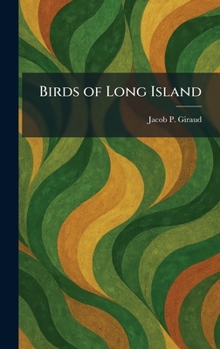
Birds of Long Island

"Birds of Long Island" is a comprehensive and foundational work of ornithology that documents the diverse avian population of the Long Island region. Written by Jacob P. Giraud, this detailed catalog serves as an essential reference for naturalists, birdwatchers, and historians interested in the ecological history of New York. The text provides systematic descriptions of numerous species, detailing their physical characteristics, migratory patterns, and habitats within the unique coastal and woodland environments of the area.
Giraud's observations offer a fascinating glimpse into the state of American wildlife during the 19th century, capturing the distribution and abundance of birds before the significant urban expansion of the following decades. From shorebirds and waterfowl to songbirds and birds of prey, "Birds of Long Island" categorizes a wide array of species with precision and scientific curiosity. This work remains a significant contribution to the field of natural history, reflecting early American efforts to classify and preserve the biological heritage of the Eastern Seaboard. It is a must-read for anyone seeking to understand the avian diversity that defines this iconic geographic region.
This work has been selected by scholars as being culturally important, and is part of the knowledge base of civilization as we know it. This work was reproduced from the original artifact, and remains as true to the original work as possible. Therefore, you may see the original copyright references, library stamps (as most of these works have been housed in our most important libraries around the world), and other notations in the work.
This work is in the public domain in the United States of America, and possibly other nations. Within the United States, you may freely copy and distribute this work, as no entity (individual or corporate) has a copyright on the body of the work.
As a reproduction of a historical artifact, this work may contain missing or blurred pages, poor pictures, errant marks, etc. Scholars believe, and we concur, that this work is important enough to be preserved, reproduced, and made generally available to the public. We appreciate your support of the preservation process, and thank you for being an important part of keeping this knowledge alive and relevant.
Customer Reviews
ThriftBooks ® and the ThriftBooks ® logo are registered trademarks of Thrift Books Global, LLC
