


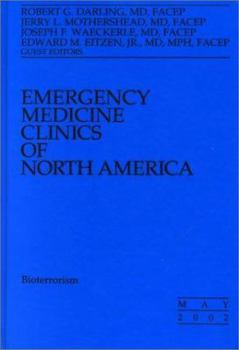
Bioterrorism (Emergency Medicine Clinics of North America, Vol. 20, No. 2)

Military and non-military experts trained to respond to victims of terrorism in the United States present a comprehensive review of biological warfare and Bioterrorism in this edition of the Emergency... This description may be from another edition of this product.
Format:Hardcover
Language:English
ISBN:0721601197
ISBN13:9780721601199
Release Date:July 2002
Publisher:W.B. Saunders
Length:535 Pages
Weight:0.57 lbs.
Dimensions:9.0" x 0.5" x 6.0"
Customer Reviews
1 rating
"Must Read" for Health Professionals/Bioterrorism Planners
Published by Thriftbooks.com User , 23 years ago
This book is a "must read" for health professionals and planners respnsible for bioterrorism preparedness. The book is the most comprehensive, thorough source of information to date on the varied aspects of planning for and responding to bioterrorism.The book begins with a historical overview of the use of biological weapons. The next two chapters, respectively, provide detailed information on the biological agents that the CDC considers to be the most dangerous and likely to be weaponized (Category "A" agents), followed by Category "B" and "C" agents - agents which have the potential to be used as weapons. These chapters include terrific consolidated tables that provide a ready reference and overview of pertinent information on each of the biological agents.The next two chapters are two of the most important in the book for health professionals and bioterrorism planners. First, the book provides an overview of the CDC's Laboratory Response Network and the most important laboratory tests and procedures for identifying biological agents. Once again the book provides consolidated tables that provide quick reference to the tests and clinical specimens required for each agent. Then the book provides a 10 step approach to identifying a biological attack by modifying the Advanced Trauma Life Support model familiar to emergency health care providers (i.e. Primary and Secondary Surveys). This "tool" can easily be adopted into medical bioterrorism plans and procedures.The book also provides an epidemiological approach to performing triage in a mass casualty, large-scale bioterroism event based on the PICE (Potential Injury/illness Creating Event)stages by expanding the "SIR" model (Susceptible, Infected, Infective, Removal) to include "Exposed" and "Vaccinated Succesfully" populations. This chapter includes an excellent graphic that summarizes this "SEIRV" methodology.A chapter on creating a basic bioterrosim incident management plan for hospitals outlines the critical issues that the plan must address, as well as some potential solutions to a few of the more difficult bioterrorism management problems. The book also addresses an area for which there has been little information previously - vulnerable populations such as children, pregnant women, the elderly and immuno-compromised patients. Once again, two consolidated tables provide excellent ready reference for anibiotic therapy for pregnant women and children.In addition, the book covers mental health issues, state and federal bioterrorism related programs, and future bioterrorism challenges and provides a community perspective on identifying and responding to a bioterrorism event.
Copyright © 2026 Thriftbooks.com Terms of Use
| Privacy Policy | Do Not
Sell/Share My Personal Information | Cookie Policy | Cookie Preferences | Accessibility Statement
ThriftBooks® and the ThriftBooks® logo are registered trademarks of Thrift Books Global, LLC
ThriftBooks® and the ThriftBooks® logo are registered trademarks of Thrift Books Global, LLC
