


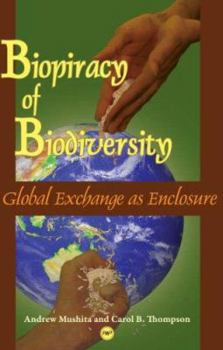
Biopiracy of Biodiversity: Global Exchange as Enclosure

Today rich countries and corporations are taking seed and making it private property. There are alos destroying seed by polluting fields with genetically modified organisms. And like pirates, they loot the wealth of others. This book gives voice to those in Africa who know better and are willing to help others see see the horror of the biopiracy and enclosure behind the camouflage of advancing innovation' and 'free trade'.'
Format:Paperback
Language:English
ISBN:1592215033
ISBN13:9781592215034
Release Date:March 2007
Publisher:Africa World Press, Inc.
Length:344 Pages
Weight:1.03 lbs.
Dimensions:8.4" x 0.9" x 5.5"
Customer Reviews
4 ratings
READ THIS BOOK!!!
Published by Thriftbooks.com User , 18 years ago
"Africa has answers to its food deficits and its food insecurity." This remarkable sentence, free of the condescension of so much written about Africa, is backed up by history and current practice in this book. Examples of indigenous farmers sharing and protecting their seed diversity are examined beside the continuing interference and attempted global control of their lands' commodities by giant corporate agribusiness. With wisdom and hope, the story of the farmers' integrity and their capability of solving the problems globalization has created become accessible in this book and, quite simply, a revelation.
A Few Lessons
Published by Thriftbooks.com User , 18 years ago
This book is useful to anyone interested in understanding the connection between biodiversity and food-security in Sub-Saharan Africa. I was pleasantly surprised by the book.
Attention! Who cares about the survival of their kids and grand-kids?
Published by Thriftbooks.com User , 18 years ago
> If you do, then read this complex, but excellent academic work (co-authored by Andrew Muchita and Carol B. Thompson), for it is <br />> vital for their, and our, future. <br />> <br />> Totally geared to huge, immediate profit from the ballooning market (resulting <br />> from the -purposely uncontrolled- population explosion), backed by millions of <br />> dollars, and by the corrupt governments they control, the multi-national <br />> corporations have been destroying the biodiversity of our crops, trying to <br />> create instant super yields. This has been done without any regard to the <br />> effects it is creating for future generations and has resulted in the fact <br />> that the monoculture of industrial agriculture has, for instance, reduced our <br />> biodiversity to only 12 plants providing 75 percent of industrialized food,. <br />> making us sitting ducks for a worldwide, modern day "Irish Potato Famine" of <br />> mega proportions. <br />> <br />> So far the corporate bio-pirates have focused on the West and Asia, and have <br />> ignored Africa and African farmers; farmers who for generations have known <br />> every inch of their soil, freely exchanging seeds, creating a huge <br />> reservoir of potent organic biodiversity. Now, however, the fast buck boys <br />> and their patent attorneys have set their sights on this diverse continent <br />> ready to resume their agricultural rape. This book explains in fine detail <br />> the who, what, where, when and how, and that it is up to us to stop them <br />> now, if we at all care for our future survival. <br />> <br />> T. van Renterghem, <br />> author, researcher, historian <br />
connecting the dots between the environment and social justice
Published by Thriftbooks.com User , 18 years ago
This book hopefully represents a new genre of social critique because it bridges multiple fields in an effortlessly readable manner. Connecting contemporary concerns about the environment, corporate malfeasance, economic and social justice and local and international acts resistance, this book will undoubtedly be used by specialists, but more importantly, it should be read by countless others who simply want to understand our world. Authors Andrew Mushita, the Director of the Community Technology Development Trust in Zimbabwe, and Carol Thompson, a Professor of Political Economy, link the environmental and global justice crises down to one essential component---the seed. Their book focuses largely on the southern African region and the current global corporations who are stealing seeds, genetically modifying them and then claiming private ownership of such seed through intellectual property rights. The brilliance of the book is that by focusing on southern Africa and seed, their story is both specific and yet sadly easy to extrapolate to others parts of the world. Interlaced with chapters about the history of past `biopiracy' from the conquest in Mesoamerica to land reform attempts in Mozambique, South Africa and Zimbabwe, the book also outlines real successes wrested from WTO by savvy coalitions of African and Indian scientists and diplomats in their attempt to maintain the integrity of original seed stocks. It's a bracing book. Carefully researched (footnotes are thoughtfully lodged at the end of each chapter) and a goldmine of data-- yet the authors are doing what Jared Diamond (Guns, Germs and Steel and Collapse) did for history, in terms of taking a complex subject formerly the preserve of academic study and rendering it in popular prose. And by tackling the 21st century, on-going problem of Biopiracy of Biodiversity in southern Africa, reading this book is arguably even more pressing.
Copyright © 2026 Thriftbooks.com Terms of Use
| Privacy Policy | Do Not
Sell/Share My Personal Information | Cookie Policy | Cookie Preferences | Accessibility Statement
ThriftBooks® and the ThriftBooks® logo are registered trademarks of Thrift Books Global, LLC
ThriftBooks® and the ThriftBooks® logo are registered trademarks of Thrift Books Global, LLC
