


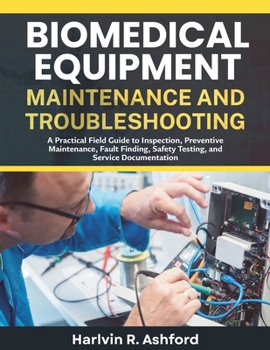
Biomedical Equipment Maintenance and Troubleshooting: A Practical Field Guide to Inspection, Preventive Maintenance, Fault Finding, Safety Testing, an

Every biomedical equipment technician (BMET), clinical engineer, and healthcare technology management (HTM) student faces the exact same challenge: academic textbooks cover abstract electronics, while manufacturer service manuals give narrow, model-specific instructions without explaining the universal troubleshooting logic behind them. When you are standing before a malfunctioning infusion pump, defibrillator, or electrosurgical unit with clinical staff waiting, second-guessing your isolation method, electrical safety test setups, or maintenance record can derail your workflow and compromise compliance.
Biomedical Equipment Maintenance and Troubleshooting: A Practical Field Guide to Inspection, Preventive Maintenance, Fault Finding, Safety Testing, and Service Documentation delivers the complete, structured framework required to service clinical medical equipment safely, systematically, and defensibly.
Built around the complete lifecycle of a service event, this comprehensive professional guide bridges foundational theory and hands-on clinical engineering practice across 18 focused chapters and 7 core parts:
Foundations of Healthcare Technology: Master the BMET service mandate, lifecycle risk classification, test equipment traceability, and clinical decontamination protocols.Structured Inspection Protocols: Step-by-step procedures for incoming acceptance testing, baseline calibration, and building risk-based preventive maintenance (PM) schedules.Systematic Fault Diagnosis: Apply the five-step diagnostic loop and split-half isolation technique to diagnose power supplies, fluidic occlusions, pneumatic leaks, and network errors.Electrical Safety and Analyzer Testing: Clear procedures for measuring ground resistance, enclosure leakage, and patient applied-part isolation under IEC 62353, IEC 60601-1, and NFPA 99 standards.Device-Class Field Reference: Detailed service, inspection, and verification workflows for high-volume equipment-including infusion pumps, defibrillators, electrosurgical units, ventilators, and patient monitors.Audit-Ready Documentation: CMMS work-order workflows, failure investigation protocols, recall actions, and quality metrics designed to keep facility records inspection-ready.Self-Assessment and Quick References: End-of-chapter review questions with an included answer key, plus comprehensive appendices containing decision trees, PM checklists, and safety limit tables.
Engineered for working clinical engineering technicians, hospital department managers, and candidates preparing for professional certification (CBET/CRES/CHTM), this field guide provides the rigorous diagnostic logic, verification boundaries, and documentation discipline required to keep clinical equipment safe, compliant, and operational.
Equip your bench, your training program, or your department with the reference that clinical engineers actually reach for when a device is on the table and the fix has to be right.
Customer Reviews
ThriftBooks ® and the ThriftBooks ® logo are registered trademarks of Thrift Books Global, LLC
