


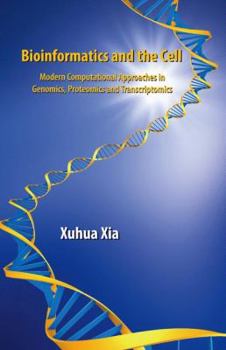
Bioinformatics and the Cell: Modern Computational Approaches in Genomics, Proteomics and Transcriptomics
No Customer Reviews

Select Format
Select Condition 
Book Overview
Biological and biomedical sciences are becoming more interdisciplinary, and scientists of the future need inte rdisciplinary training instead of the conventional disciplinary training. Just as Sean Eddy (2005) wiselypointed out that sending monolingual diplomats to the United Nations maynot enhance international collaborations, combining strictly disciplinary scientists trained in either mathematics, computational science or molecular biology will not create a productive inte rdisciplinary team ready to solve interdisciplinary problems. Molecular biology is an interdiscip linary science back in its heyday, and founders of molecular biology were ofte n interdisciplinary scientists. Indeed, Francis Crick considered himself as "a mixture of crystallographer, biophysicist, biochemist, and geneticist" (Crick, 1965). Because it was too cumbersome to explain to people that he was such a mixture, the term "molecular biologist" came handy. To get the crystallographer, biophysicist, biochemist, and geneticist within hi mself to collaborate with each other probably worked better than a team with a crystallographer, a biophysicist, a biochemist and a geneticist who maynot even be interested in each other's problems.
Format:Paperback
Language:English
ISBN:1441943919
ISBN13:9781441943910
Release Date:November 2010
Publisher:Springer
Length:350 Pages
Weight:1.13 lbs.
Dimensions:0.8" x 6.1" x 9.2"
Customer Reviews
0 rating
Copyright © 2026 Thriftbooks.com Terms of Use
| Privacy Policy | Do Not
Sell/Share My Personal Information | Cookie Policy | Cookie Preferences | Accessibility Statement
ThriftBooks® and the ThriftBooks® logo are registered trademarks of Thrift Books Global, LLC
ThriftBooks® and the ThriftBooks® logo are registered trademarks of Thrift Books Global, LLC
