


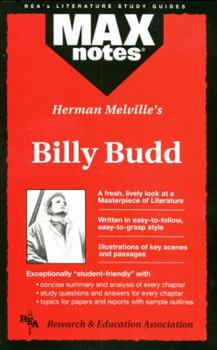
Billy Budd (Maxnotes Literature Guides)

REA's MAXnotes for Herman Melville's Billy Budd MAXnotes offer a fresh look at masterpieces of literature, presented in a lively and interesting fashion. Written by literary experts who currently... This description may be from another edition of this product.
Format:Paperback
Language:English
ISBN:0878910077
ISBN13:9780878910076
Release Date:March 1996
Publisher:Research & Education Association
Length:96 Pages
Weight:0.25 lbs.
Dimensions:0.2" x 5.3" x 8.3"
Age Range:16 years and up
Grade Range:Grade 11 and higher
Customer Reviews
5 ratings
good and evil
Published by Thriftbooks.com User , 20 years ago
Personally, I thought this was a great book. This book follows a man named Billy Budd through the end of his life spent in the English navy. Although this book had some boring parts, it was overall a great story line. I was impressed with story more than the writing, which ran a little longer than I thought it should have in some parts. However, the main story was very clever and presented a lot of great ideas. The story was set in 1797 during one of Britain's wars with France. Most of the story takes place on a ship called the Indomitable. There had been a lot of mutinies in the British navy, and the ship is overall a tense place. To add to it the men find the quarters too crowded. Billy Budd starts out on a boat called the Rights of Man, a merchant ship, and is put into service on the Indomitable. The story to me is about good versus evil. The whole book seems to be a major analogy of the simplest form. Billy is good. Claggart is bad, and Vere is reason. The major plot involves Billy killing Claggart in response to evil. Billy seems to be completely unaware of badness. After being offended by Claggart, Billy punches him and accidentally kills him. Then a court is set up to determine Billy's punishment. The characters have very obvious symbolism to the struggle of good and evil. When Billy joins the Indomitable he is about 20, handsome, kind, and basically personified innocence. Claggart is an older man who moved up in rank mainly because he could please people, but is clearly evil. I think that this is genius. Even in my life I can think of people who get ahead in life simply through attitude, which I find to be a horrible representation of a man. I believe men should be judged more on their values, or set of morals, which determine all of his endeavors. Even in schools the straight A students are not always the people who are most able to do jobs. However I use this more as an analogy than an example because this story deals mainly with good and evil. Finally, there is Captain Vere. He is an older man, who is implied to be intelligent although not directly show to be. He loves to read, and is a conserved man who is seen as fair, and well liked among the sailors. To me he doesn't represent a person. I see Vere as the challenge of judgment. He is a man given all the information, a just fairness, and intelligence. I find that even though not all people come off as having equal intelligence, it's more of a language barrier. Until you get to know someone its like looking at the surface of an ocean. When it comes to their ideas you can only see the tip of the iceberg, and it's impossible to tell for sure how deep those thoughts go, even if you think you have an idea. I think that most people have this reason and understanding, under the surface, that is represented by Vere. I must say that some people wouldn't like this book because they might find it stupid or boring, but the principles that are suggested by this book are real and true to today.
Natural depravity
Published by Thriftbooks.com User , 20 years ago
The inmates of the 'Indomitable', the name of the ship, which is the centre stage of the evolving drama, have indomitable reactions. Innocence as well as antipathies are 'spontaneous and profound'. Man is irrational. He is governed by the heart, not the brain, but the heart can be innocent or evil: 'though the man's even temper and discreet bearing seem to intimate a mind peculiarly subject to the law of reason, not the less in his heart he would seem to riot in complete exemption from the law, having apparently little to do with reason further than to employ it as an ambidexter implement for effecting the irrational. These men are true madmen.' More, civilization is auspicious to natural depravity. It folds itself in the mantle of respectability. The innocent Billy Budd (Adam before the Fall) is a victim of profound iniquity (pale ire, envy, despair) and his reaction is indomitable. Starry Vere (fron the Latin 'Verus'), the captain of the ship, agrees that iniquity is a mystery, a matter for psychologic theologians, but for a military court only the prisoner's deed must be taken into account. Herman Melville, as a true calvinist, is obsessed by the existence of evil. He wrote a profound and dramatic masterpiece.
As Relevant Today As It Was in 1891 - Wonderful !
Published by Thriftbooks.com User , 21 years ago
. Many lessons in the story of Billy Budd. And one is the personality of the master-in-arms, John Claggart. How does one explain in our current life persons who lash out at us for false reasons due to alterative motives? We can dispute the charges but when asked what reason we believe the reputable and well-respected person is accusing us for, what is our answer? This is where reading books, anything from philosophy, psychology, novels, biographies, etc., are so crucial in life. Crucial in all our endeavors, from cliché speech walking in our neighborhood to who we vote for politically. And so, here we are accused for motives beyond surface despite the respectability and dignity that the accuser so verily has. If we and our judges are familiar with the stories of the biblical Joseph and his brothers, and I find much more so, the story of John Claggart and Billy Budd, then our referral to such stories reaps far more insight than a lengthy explanation would do. Another point that hit hard is at the end of the novel, where Melville quotes the fictitious Newspaper's account of the Billy Budd story potraying him as the culprit and I can't help but compare it to the stories of the media and journalism that conveys the right story but subtly changes. omits and slyly maneuvers the intents and motives and in many cases, outright falsifies the information as in "Billy Budd conspires mutiny and thus punished appropriately." But what makes matters so much worse is the believing public, "Billy Budd really is evil," naive, built on journalism where the reading of books is long forgotten. Were Captain Vere and the three lieutenants correct in their decision to execute Billy Budd? Should the letter of the law been obeyed? Or did this incur extenuating circumstances to pardon either the official crime or the punishment? This was a time of recent mutinies and revolts on other ships, although nothing of the sort here happened, it pervaded the spirit of strict disciplinarian measures. In addition, the outcome of the obedience and servitude of the sailors and officers would have to be weighed ahead of the life of Billy Budd, despite is false accuser and impulsive blow to counter act his failure to use speech to defend himself. Does this support a zero tolerance law code? Or should flexibility and discernment above strict adherence to each and every case be determined by the spirit and purpose of the law broke rather than then the letter of the so-called infringement? Subjectively, Billy Budd was a good man and innocent of the death by accident he incurred to Claggart and therefore should be either found guilty of a lesser charge or given lesser punishment. Billy Budd's last words, "God Bless Captain Vere." Objectively, Billy Budd broke a major law, killing a superior officer, which in turn, has a major influence on the entire fleet of sailors and officers and is therefore guilty and subject to hanging.
Power and magnificence overcomes difficult writing
Published by Thriftbooks.com User , 25 years ago
This novella is difficult to read, with long and complex sentences and perhaps unnecessary diversions. But its power and depth reward the effort it takes to read it."Billy Budd" is an allegory of a young seaman who strikes and kills a superior officer when the officer's cruelty and treachery become unbearable. The focus of the story is the debate over whether to execute the seaman (Billy Budd) for his crime. With passionate and terrifying logic, Melville (through the voice of Captain Vere) demonstrates that human perfection is impossible - not because we humans are weak, but because perfection simply does not and cannot exist in this world. To make decisions based on our notion of "divine justice" is not only impractical and foolhardy, according to Melville, but even immoral.If you like to think of yourself as an idealist, then reading this book will leave some unanswered questions in your mind, possibly for the rest of your life. I first read this story more than thirty years ago, and it still affects the way I think about almost everything to this day.
Billy Budd is an historic event
Published by Thriftbooks.com User , 27 years ago
While much has been said about the value of the work itself, Billy Budd is important not only as an allegory, but as a fictionalized account of an actual event in the 1840s. The real Billy Budd was Philip Spencer, the son of the Secretary of War at the time. Spencer left Union College after founding the first social greek letter society, Chi Psi. He signed on with a training ship, the Brig of War Somers. The Somers was overcrowded with young recruits and captained by a paranoid zealot. Midshipman Spencer was falsely accused of fomenting mutiny and ultimately hung from the yard arm rather than betray the fact that he was recruiting for his fraternity. The need for secrecy was particularly keen, since his own father was famous for his prosecution of the Masons based on alleged murder to prevent the masonic secrets from being disseminated. His hanging was not only against the law at the time, but also offended all sense of fairness. Following the investigation of his murder, it became emphatically clear that it was necessary to change the way the United States was to train its navy. The direct result was the founding of the United States Naval Academy, in whose museum Midshipman Spencer's sword is on display.
Copyright © 2026 Thriftbooks.com Terms of Use
| Privacy Policy | Do Not
Sell/Share My Personal Information | Cookie Policy | Cookie Preferences | Accessibility Statement
ThriftBooks® and the ThriftBooks® logo are registered trademarks of Thrift Books Global, LLC
ThriftBooks® and the ThriftBooks® logo are registered trademarks of Thrift Books Global, LLC
