


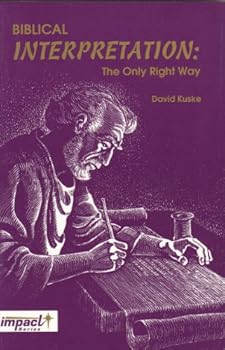
Biblical Interpretation: The Only Right Way (Impact Series)


Select Format
Select Condition 
Book Overview
The Impact Series features crucial titles on a variety of topics, including denominations, doctrine, and cultural issues. With practical applications for Lutherans and other Christians, these books... This description may be from another edition of this product.
Format:Paperback
Language:English
ISBN:0810005727
ISBN13:9780810005723
Release Date:January 1997
Publisher:Northwestern Publishing House
Length:240 Pages
Weight:0.60 lbs.
Dimensions:8.5" x 0.5" x 5.5"
Customer Reviews
3 ratings
Must read for serious objective biblical study
Published by Thriftbooks.com User , 20 years ago
Kuske's book should be required material at seminaries across this country. It should also be used for educating people of how biblical interpretation is done properly. In an age where historical-critical methods of interpretation have overwhelmed publishing companies and caused so many to stumble in their faith, Kuske's book is a breath of fresh air (although the method he describes is old, but forgotten). This book correctly discusses the Historical-Grammatical method of interpretation. Kuske adds "Scriptural" to this method (Historical-grammatical-Scriptural)in the book, even though it has always been understood in the historical grammatical method. Readers will learn to humble themselves before the Word of God and let it be the teacher. The historical-critical method puts man in judgment over the Scriptures, and subjectivity is the norm. On that path it doesn't take long to reach apostasy. Kuske's book is a must read for learning how to interpret the Scriptures. It could be read by anyone interested in properly reading God's Word.
Outstanding Intro Book to Biblical Interpretation
Published by Thriftbooks.com User , 24 years ago
I utilize this book in an adult bible curriculum (ABC's) with the first class in a sequenced order called "Learning to Use Your Bible."It provides an excellent overview both to interpretation principles themselves and to the history of interpretation.His foundation of word usage derived from Biblical usage is right on. Too much is made out of etymology. Sometimes it is useful, but more to the point is how it is utilized by the Biblical writers.I find his textual criticism to be in line with what I learned and practice. Although much of this might be cumbersome and discouraging to the layperson, a intro acquaintance with the subject has proven itself useful to my parishoners.Seminarians/Pastors likely will gravitate on to more substantial works on the subject. I would suggest calling the sem bookstores to check out what the profs are having the students read for Hermeneutics class: old volumes we used included Mickelsen and Terry, and likely Voelz contribution "What Does This Mean?" will be instructive to the modern exegete as well.Highly recommended.
Solid meat for the layperson and pastor alike
Published by Thriftbooks.com User , 26 years ago
This is an easy-to-read book suited to the pastor and layperson alike. Although this text may not be as detailed as some other books on biblical interpretation, what Kuske puts is print is worth reading. Kuske puts forth and explains six principles for interpreting Scripture: 1) The only books that are God's Word are the canonical books of the Bible, 2) the only worldview of Scripture is the supernatural, 3) the only text that is determinative is the original, 4) the only literary criticism to be done is the external king: the historical setting, and 6) the only meaning of the words is the simple, plain meaning: the grammatical setting.The rest of the text covers biblical interpretation though Christian history, including some of the weaknesses of modern, historical-critical methods of interpretation.This reviewer's only thoughts concerning Kuske's correctness on all his assertions revolve around two points. First, Kuske may favor variant readings a bit much as he urges that since only the original text is the inspired text, one should favor the oldest and most widespread manuscripts (true). However, the early Greek church carried out this process quite extensively with more material available to them; so the majority text, which is not synonymous with the Textus Receptus, should not be cast aside because it is not illumined by the aura of recent discovery. Also, Kuske puts forward that to decide what a particular word means is to see how the Bible uses it. This involves three things: 1) How does the Bible use a word in a verse or surrounding verses? 2) How does the Bible use a word throughout the Bible? 3) What a word traditionally has meant (etymology)? All three principles play an important role in learning the meaning of as passage or word. Nevertheless, immediate context should always take prime consideration, something that this reviewer believes Kuske did not stress enough.Be aware, however, that the two criticisms mentioned in this review are very minor in relation to what treasures of gold that Kuske uncovers; do not let them dissuade from the reading and using of this book. This text is very accessible, but never patronizing; a most worthy effort.
Copyright © 2026 Thriftbooks.com
Terms of Use | Privacy Policy | Do Not Sell/Share My Personal Information | Cookie Policy | Cookie Preferences | Accessibility Statement
ThriftBooks ® and the ThriftBooks ® logo are registered trademarks of Thrift Books Global, LLC
ThriftBooks ® and the ThriftBooks ® logo are registered trademarks of Thrift Books Global, LLC
