


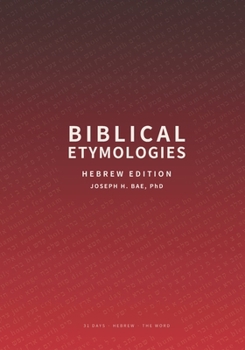
Biblical Etymologies: Hebrew Edition - 31 Hebrew Roots, One Verse and One Root a Day

Every Hebrew word in the Old Testament is built on a skeleton of three consonants.
Learn the skeleton and a wall of strange letters turns into words you can take apart - and the pictures inside them. bara (create), mayim (water), ruach (spirit, wind, breath), qadosh (holy), shem (name), melekh (king), lev (heart), nefesh (soul), katav (write), shalom (peace, whole), shema (hear), yasha (save), ḥayyim (life), bayit (house) - and the rest of the way to the end of the story.
Each day takes one root from the Hebrew text. The verse it lives in (NKJV). The three letters, and what they are doing. The words built from them. A Bible connection at the centre of every day, where the Old Testament itself does the teaching, and a Gospel thread running through the whole book. Hebrew is set right to left and every word carries its transliteration, so a reader who has never seen the alphabet can work through the day.
The thirty-one days follow the shape of the whole story, in seven movements: In the beginning - The King of glory - All have sinned - According to the Scriptures - The Gospel - Faith comes by hearing - Walk in newness of life. The spine of it is 1 Corinthians 15:3-4 - Christ died for our sins, was buried, and rose again the third day, according to the Scriptures.
How it began. During the pandemic the author sat at home with his seven-year-old son and memorised all 176 verses of Psalm 119 - in Korean. Twenty-two stanzas of eight verses: twenty-two, because that is how many letters sit in the Hebrew alphabet, and the psalm is an acrostic, each stanza belonging to one letter from aleph to tav. By the time they could say the psalm, they could say the alphabet it is built on. This book is what came next.
31 one-a-day lessons, about 25 minutes eachOne Scripture verse a day (NKJV), chosen so the day's root appears in itHebrew read right to left, with transliteration for every wordA Bible connection at the centre of every day, and a Gospel thread through the whole BibleHebrew 101 - a first lesson on the letters, for readers who have never met themAnswers for every day, collected at the back of the bookAges 11-14, and the adults reading over their shouldersHebrew volume. Companion volumes: Classical Etymologies - Greek and Latin.
Customer Reviews
ThriftBooks ® and the ThriftBooks ® logo are registered trademarks of Thrift Books Global, LLC
