


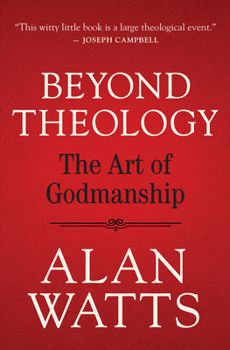
Beyond Theology: The Art of Godmanship


Select Format
Select Condition 
Book Overview
A radical reinterpretation of Christianity by one of the twentieth century's leading philosophers Today, Alan Watts is remembered mainly as an eloquent interpreter of Eastern philosophies such as Taoism and Zen Buddhism. Not everyone knows that Watts was also a formidable scholar of Christianity who worked as an Episcopal chaplain early in his career. He eventually left the church to find his own spiritual path, but his time there fueled a burst of literary creativity that culminated in Beyond Theology, originally published in 1964 and now back in print.
In this landmark work, Watts asks whether a "rigorous, imperious, and invincibly self-righteous" religion such as Christianity can stay relevant in our modern, multicultural world. To answer that question, he deconstructs Christianity by using concepts borrowed from psychology, linguistics, science, and Eastern philosophy. In the process, he solves difficult problems of theology, traces the impact of Christianity on Western culture, and points the way to a new form of nondualistic spirituality. Playing the role of a philosophical jester, Watts artfully deploys paradoxes, riddles, and gently subversive humor to overturn conventional wisdom. His intention is not to hold sacred things up to ridicule but rather to expand our definition of the sacred. The ultimate aim is to help us see beyond the external trappings of religion -- beyond ritual, myth, doctrine, and theology itself -- to experience the divine within ourselves.
In this landmark work, Watts asks whether a "rigorous, imperious, and invincibly self-righteous" religion such as Christianity can stay relevant in our modern, multicultural world. To answer that question, he deconstructs Christianity by using concepts borrowed from psychology, linguistics, science, and Eastern philosophy. In the process, he solves difficult problems of theology, traces the impact of Christianity on Western culture, and points the way to a new form of nondualistic spirituality. Playing the role of a philosophical jester, Watts artfully deploys paradoxes, riddles, and gently subversive humor to overturn conventional wisdom. His intention is not to hold sacred things up to ridicule but rather to expand our definition of the sacred. The ultimate aim is to help us see beyond the external trappings of religion -- beyond ritual, myth, doctrine, and theology itself -- to experience the divine within ourselves.
Format:Paperback
Language:English
ISBN:1608688240
ISBN13:9781608688241
Release Date:October 2022
Publisher:New World Library
Length:288 Pages
Weight:0.68 lbs.
Dimensions:0.8" x 5.2" x 7.9"
Customer Reviews
2 ratings
Hindu interpretation of Christianity
Published by Thriftbooks.com User , 21 years ago
This is the last book Watts wrote before his classic The Book: On the Taboo Against Knowing Who You Are. Like that more popular book, Watts explores the central belief systems of Hinduism: that all is one, and individual beings (e.g., the deep self or "Atman") and things in time are illusory projections ("maya") of an eternal, infinite Godhead (i.e., "Brahman") that plays tricks on itself ("lila") for the sake of divine entertainment. Watts makes the interesting point that Christianity can be true from the vantage point of Hinduism, but not vice versa: while Christianity rejects other traditions out of hand, Veddic belief systems can absorb Christianity as one of the most striking dramas ever invented: a captivating show in which the human soul is directed to do the right thing by an infinitely greater Creator whose ultimate castigation is eternal damnation. Watts asks how we can know which is true, and says we can't, although he seems at this point in his life to side with the Hindu-Christian viewpoint espoused here. In The Book, he will drop much of the effort to incorporate Christianity, coming up with a "cleaner" belief system; later in his life he moves more toward Taoism, which is more concerned with process than truth. One criticism I have of this fascinating book is that Watts identifies what he calls the "vague consensus of science" with the contrast of conscious human life in an inert, dead and mechanical, universe. But this interpretation of the modern science worldview, although dominant, is Caresian and neglects Spinoza's interpretation which provides an alternative with a perhaps higher truth quotient even than the fascinatingly tolerant interpretation of ultimate reality Watts develops here.
Fast paced and readable
Published by Thriftbooks.com User , 22 years ago
_Beyond Theology_ is an excellent work for those who are new to Alan Watts, or theology in general. It is fairly easy to read, and has a type of agnostic flavor to it that might be appropriate for people who want to dabble in low-maintenance spirituality. But even for the serious reader of Alan Watts and serious theological students, I would still recommend this one because it is rather effortless and relaxing, while providing some profound psychological insights. It is also a key transitional work bridging the gap between Watt's earlier Western-religious works, and his later Eastern-religious works. With _Beyond Theology_, you can see the beginnings of what was to become a more pantheistic and almost nihilistic type of sprituality. If you want to really understand Watts' later works, you must read his magnum-opus _Psychotherapy East and West_ in addition to this one.
Copyright © 2026 Thriftbooks.com Terms of Use
| Privacy Policy | Do Not
Sell/Share My Personal Information | Cookie Policy | Cookie Preferences | Accessibility Statement
ThriftBooks® and the ThriftBooks® logo are registered trademarks of Thrift Books Global, LLC
ThriftBooks® and the ThriftBooks® logo are registered trademarks of Thrift Books Global, LLC
